

The mission will include a constellation satellite to monitor methane gas emissions and two satellites to monitor methane gas emissions. World’s largest 5G narrowband – IoT constellation
Kongsberg NanoAvionics (“NanoAvionics”), a leading small satellite bus manufacturer and mission integrator, announced that four of its manufactured satellites will be placed into orbit aboard the upcoming SpaceX Transporter-10 mission.
NanoAvionics’ three customers in this rideshare mission are Luxembourg’s OQ Technology, the world’s first global company; Satellite 5G IoT (Internet of Things) operator, Spanish Earth Observation (EO) company Satrantis, and South Korean Contec, a ground station operator and service provider.
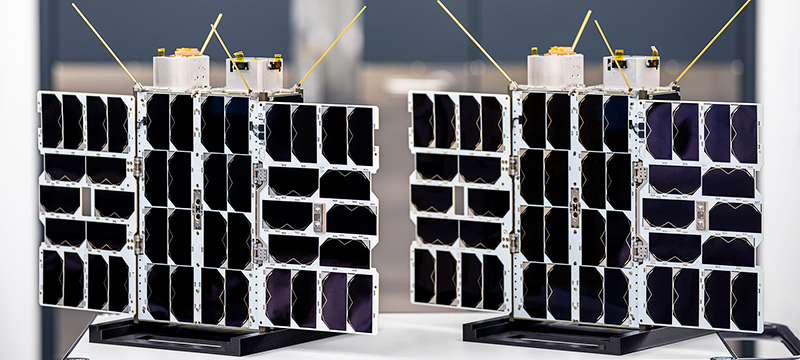
OQ Technology’s microsatellites Tiger-7 and Tiger-8 expands the world’s first and largest 5G narrowband IoT constellation in low Earth orbit (LEO) to 10 satellites. The two 6U microsatellites constitute his fifth and his sixth manufactured by NanoAvionics for OQ Technology. All of OQ Technology’s constellation satellites can connect directly to off-the-shelf IoT devices and machines to provide tracking and monitoring information.
The 16U HORACIO satellite will be Satrantis’ third satellite to launch the iSIM-90 imager into space. Its high-resolution data provides insight into multiple EO applications, including infrastructure monitoring, methane gas emissions quantification, food security, and coastal and border awareness.
The CONTECSAT-1 satellite is aimed at companies and organizations that need data on the marine environment, urban management, agriculture, etc. The 16U nanosatellite integrates a 1.5 m resolution multispectral imager provided by NanoAvionics partners. This will allow Contec to create customized satellite imagery for its customers.
Gilvinas Kvedaravicius, CEO of Kongsberg NanoAvionics, said: “Our continued record of success in building and launching nanosatellites and microsatellites for individual missions and constellations has established us as one of the leading small satellite manufacturers and mission operators in the United States and Europe. It proves our position. The continuous production of satellites for existing customers is also confirmation and validation of the high quality and cost-effectiveness of our products and services. As a result, nanoavionics has successfully launched more microsatellites over the past five years than any other external manufacturer in the world, and we are also seeing a rapid increase in demand for our microsatellite buses.”
