

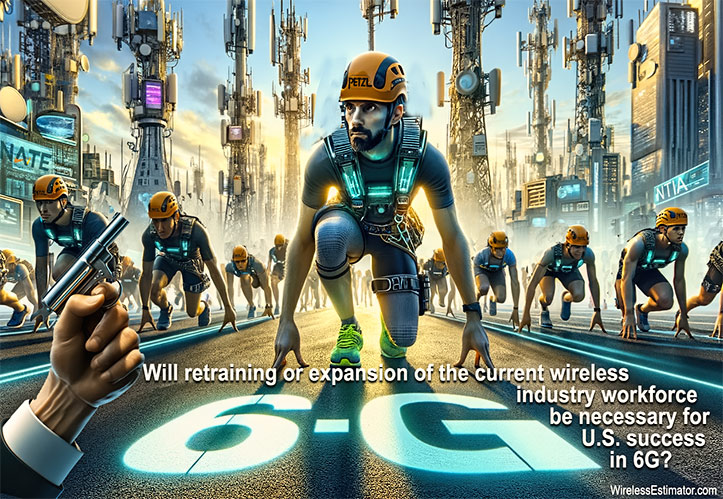
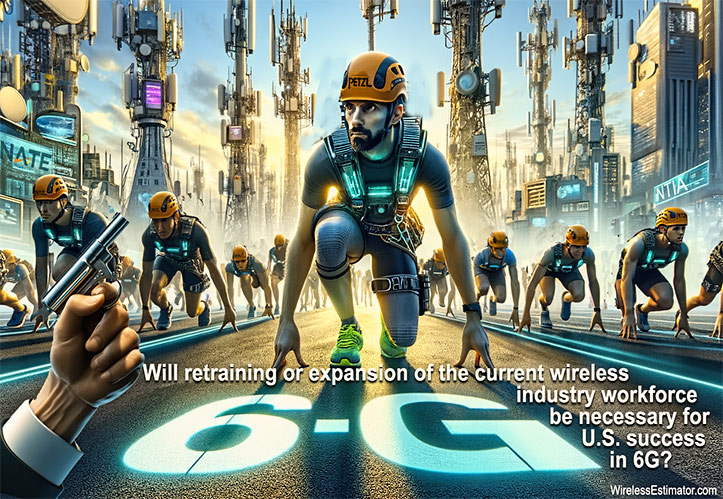
NTIA questions whether the current wireless industry workforce will need to be retrained or expanded when 6G is deployed, although until more information is available about non-standardized 6G wireless systems, this question may be difficult for WIA, NATE, or other industry stakeholders to answer.
At Connect X in Atlanta last week, panelists in multiple sessions estimated that 5G is deployed in about 50% of the U.S. But the National Telecommunications and Information Administration (NTIA) wants to get 6G rolling sooner, and the agency is seeking public input to help guide agency policy on the development of next-generation wireless communications technology.
As stakeholders in industry, government, academia, and private society develop potential requirements for 6G, NTIA would like to hear from the public on specific questions to inform future engagement and support for 6G developments.
NTIA states that secure and reliable communications are essential to U.S. economic competitiveness. As 5G deployment advances, the industry is already planning for 6G, which is expected to provide pervasive connectivity across the digital and physical realms, leading to improved economic growth, national security, and social welfare. Various organizations, including the International Telecommunication Union and the U.S. NextG Alliance, are developing 6G visions.
6G is expected to build on 5G capabilities, expanded connectivity, integrated sensing, communications, and artificial intelligence. It has the potential to achieve societal and economic goals, including public safety, security, resilience, economic competitiveness, and digital equity. To ensure these goals are met, NTIA is seeking comments from stakeholders to inform policy positions that support U.S. leadership in 6G development and global standards.
Request for comments
NTIA invites comment on a range of issues related to 6G technology, including priorities, use cases, research and development, and more. Comments are welcomed from private sector stakeholders, academia, civil society, and the public sector. NTIA specifically welcomes comments on the following questions:
- These are the enablers of 6G success: what specific use cases will be the first to benefit from 6G technology, and how can the U.S. government support these innovations?
- Policy Support: What existing or future policies should the U.S. government pursue to support 6G development beyond spectrum use? What policies could hinder 6G development or undermine U.S. competitiveness in international markets?
- Challenge: What new challenges will 6G raise regarding privacy, fairness, and civil rights? How can the U.S. government ensure that the benefits of 6G technology reach all segments of society?
- International collaboration: How should the U.S. government work with like-minded countries to make 6G a global success? Are there existing international efforts on 6G that should be considered?
- Leadership and competition: Are U.S. companies positioning themselves as global leaders in 6G development? Which other countries and regions pose the greatest challenges to U.S. leadership in 6G? What can the U.S. government do to help U.S. companies succeed in the global 6G market?
- Adoption barriers: What barriers need to be addressed to deploy 6G in non-traditional sectors such as industry and academic campuses?
- Workforce development: What will it take to develop a domestic workforce capable of designing, manufacturing, deploying and operating 6G networks? Will there be a need to retrain or expand the current workforce?
- Public-Private Partnerships: What public-private partnerships could help achieve U.S. leadership in global 6G development?
- Standards and interoperability: How are standards being set or developed to ensure that 6G supports interoperability between multiple communications infrastructure suppliers?
- Transitioning from 5G to 6G: What can be done today in 5G development to ensure 6G is a success? How should these efforts be prioritized?
- Supply chain issues: What supply chain issues in 5G deployment could impact 6G development? How does the 6G supply chain differ from the 5G supply chain?
Additional information is available here.
