


Aftermath of WRC-23 and NTIA’s National Spectrum Strategy
As the curtains came down on the World Radiocommunication Conference 2023 (WRC-23) in Dubai last December, the airwaves were buzzing with more than just radio frequencies. This year’s conference marked a significant step in the evolution of global communications, setting the stage for the future of wireless broadband services, satellite communications, and other communications services. At the conference, governments from around the world came together to negotiate radio frequency spectrum allocations and update the Radiocommunication Regulations, the international treaty that governs spectrum use and satellite orbits.
The exponential growth in wireless traffic is creating major challenges for wireless operators. According to the latest data from Research and Markets, global mobile data traffic is projected to grow 27.9% annually between 2022 and 2030.
As we look ahead to the development and deployment of next-generation wireless technologies, there is a need to identify and open up 6G spectrum in a timely manner. Identifying additional spectrum for terrestrial broadband wireless services to fuel continued economic growth remains a top priority.
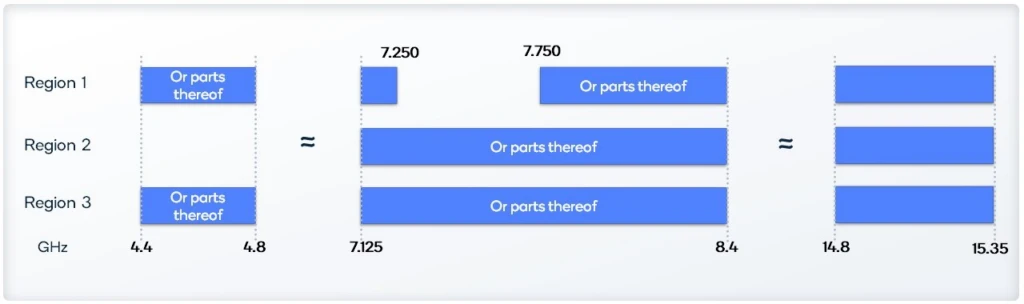
Mid-band frequencies agreed at WRC-23 for global research.
Post-WRC-23 Impact
WRC-23 harmonised the existing International Mobile Telecommunications (IMT) band (the 3 GHz band) and added a new band for wireless broadband, namely the upper 6 GHz band (6.425-7.125 GHz).
WRC-23 also set the agenda for the next World Radiocommunication Conference (WRC-27) to be held in 2027, providing a clear roadmap for future IMT spectrum allocations. One of the most influential agenda items of WRC-27 is the identification of several frequency bands for potential use for IMT, including 4.4-4.8 GHz, 7.125-8.4 GHz, and 14.8-15.35 GHz.
Between the two conferences, the following bands will be studied for potential identification of IMT: The 4.4-4.8 GHz band or parts of it will be studied in Region 1 (Europe, Middle East, Africa) and Region 3 (Asia Pacific). The 7.125-8.400 GHz band or parts of it will be investigated in Americas (Region 2) and Region 3. Additionally, the 7.125-7.250 GHz band and the 7.75-8.4 GHz band or parts of it will be considered in Region 1. In all regions, the 14.8-15.35 GHz band will be considered.
The importance of these studies cannot be overstated.
As demand for wireless broadband services continues to surge due to the proliferation of increasingly demanding mobile devices, IoT devices, new AR/VR headsets, and the advent of 5G technology, the need for more spectrum is becoming more urgent.
The sharing and compatibility study will also consider the protection needed for a range of current services, from satellite to aviation services. The bands being considered for IMT identification are particularly attractive because of their potential to support the next generation of faster, higher capacity wireless networks.
Modernizing U.S. Spectrum Policy
In November 2023, just prior to WRC-23, the U.S. National Telecommunications and Information Administration (NTIA) released the National Spectrum Strategy (NSS), which aims to strengthen federal agency capabilities while fostering private sector innovation. The NSS outlined plans to modernize spectrum management policies and allocated large swaths of the radio frequency spectrum to potential new uses.
Among the bands identified in the US NSS is the 7.125-8.4 GHz band, which was specifically called out for study on licensed and unlicensed wireless broadband use. The move underscores the US commitment to exploring more constrained and challenging spectrum bands to meet the growing needs of the digital economy.
To achieve this goal, the recently released NSS Implementation Plan outlines an approach to achieve strategic objectives to ensure spectrum resources are available to support private sector innovation: NTIA and involved federal agencies will conduct research in collaboration with industry and academia.
The implementation plan lays out a roadmap for multiple studies of spectrum bands for potential reuse or sharing, long-term spectrum planning, and efforts to develop a more skilled workforce.
Final reports on the spectrum band studies are expected to be delivered at various intervals over the next 2.5 years. With the release of the implementation plan, stakeholders will begin studying bands such as the 3GHz band (3.1-3.45 GHz) and the mid-high band (7.125-8.4 GHz) for mobile use. These studies, expected in October 2026, will pave the way for 6G connectivity and more efficient spectrum utilization, ensuring that spectrum resources are aligned with the Administration’s key policy objectives.

Powering next-generation experiences and innovative use cases.
What’s next?
As we enter the 21st century, global spectrum harmonization is critical to significantly improve performance while lowering equipment costs. Collaborative efforts between governments, regulators, and industry players at conferences such as WRC-23 help pave the way to a more connected, technologically advanced future. The decisions at WRC-23 and the release of the NSS represent a broader shift in spectrum management, where spectrum resources are being reassessed and studied to address the fundamental needs of a constantly changing society.
As the world eagerly anticipates the innovations that will be reflected in the next generation of wireless technologies, one thing is clear: the foundation laid in these spectrum studies will shape our continued economic success and national security. ITU’s research findings and the strategic vision outlined in the NSS are about more than just allocating spectrum; they’re about unlocking the potential of new technologies, including 6G, and services that will transform the way we live, work and communicate.
Want to learn more?
Download the Latest Spectral Updates and Innovations Presentation
Sign up for the What’s Next in Wireless Technology newsletter
