

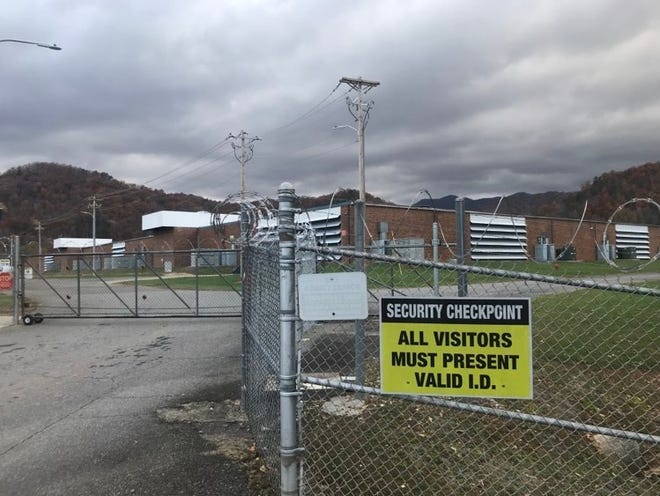

MARSHALL – At its March 19 meeting, the Madison County Planning Commission’s biomass moratorium was not the only one tasked with expiring soon, as the county’s data processing facility moratorium is also scheduled to end. be.
As a result, the County Planning Commission met to strengthen the draft land use ordinance language regarding such facilities.
Similar to the recommended biomass language in land use ordinances, the county planning commission’s recommendations go to the Madison County Commission, which votes on whether to approve, modify or reject the recommendations.
Madison County has set a grace period starting June 13, 2023, to include language in the ordinance that makes no reference to such facilities, according to Development Services Director Brad Gass.
At a meeting in June 2023, Gass said, “Data processing facilities are just a fancy way of talking about virtual currency mining facilities, but in terms of server farms, they are large scale facilities like Apple, Google, and Facebook. “This includes data centers.”
“They’re all lumped together in zoning. There’s nothing in the current land use ordinance that deals with data processing centers. So we’d like to have an opportunity to study that issue and establish some standards. I believe that there is probably a special use of the data processing facility in the ordinance.”
Gass said the moratorium will give the county a year to develop guidelines.
That’s exactly what the Madison County Planning Commission was aiming for at its March 19 meeting.
In its proposed recommendation, the Planning Commission defines a data processing facility as “a site designed and used primarily to host computer systems and related components, such as communications and storage systems.” This includes data centers that specialize in processing, storing, and distributing data. Facilities range in size from small server rooms to large data farms. ”
Similar to the biomass regulations, the county planning commission is proposing to separate such facilities into two categories. A small facility is defined as having up to 10,000 square feet of server space, and a large facility is defined as having more than 10,000 square feet of server space. .
Small-scale data processing facilities are permitted within commercial zones. According to the proposed changes, large-scale data processing facilities would be relegated to industrial zones, with specific standards addressing infrastructure needs such as access to high-capacity power lines and high-speed communications networks.
Marshall resident Elaine Robbins and Hot Springs resident Barbara Zimmerman expressed concern about the “large amounts” of water used to cool data processing systems, and both asked the county planning commission to protect local water sources. He emphasized that he hopes that regulations will be included.
Ira Teague, another resident who attended the meeting, said the board could reach out to board members in other counties in the state to get feedback because Cherokee County has an existing facility. Proposed.
As Sarah Honosky of the Asheville Citizen-Times reported, the Buncombe County Commission on May 2 approved a one-year shutdown of the data processing facility.
At the May 2, 2023, Buncombe County Commissioners meeting, Mountain True Health Community Director Chris Joyel thanked the county for its “proactive” response to this issue.
Details: 1-year ban on Madison data centerMadison County imposes 1-year moratorium on data processing facility
Details: Bancom 1 year data processing banBuncombe County approves one-year moratorium on cryptocurrency mining while reviewing regulations
“MountainTrue has witnessed several virtual currency mines operating in WNC, particularly Cherokee County, that have proven to be a nuisance to nearby residents and a threat to the environment.” Mr. Joyel said.
Joyel also attended the March 19 Madison County Planning Commission meeting and emphasized that e-waste from data processing facilities is a “very serious problem.” Joyel reassured Robbins and Zimmerman’s concerns about water by telling board members and attendees that the county would need clearance and drainage permits.
“If they’re returning water that’s 5 degrees warmer than when they passed through it, I think that would require a change in temperature as well,” Joyel said.
County Land Use Attorney John Noor also reassured residents.
“Water is generally not an issue,” Noor said.
Both e-waste and Styrofoam waste are the two most serious problems at Cherokee County facilities, said Joyel, who has worked with Cherokee County and its three existing facilities.
“These facilities are disassembling servers on a daily basis, so the packaging that all this equipment is in is going to a landfill and it can’t be compressed,” Joyel said. “Then Cherokee realized that they would be maxing out the capacity of the landfill virtually overnight.
“We have to keep in mind that waste disposal can be a real issue.”

requirements
The draft language lists numerous requirements regarding height, separation of uses, filing requirements, access, safety fencing, screening, public works notices, signage, and noise.
The land use ordinance changes recommended by the Planning Commission include an 8-foot minimum height. The structure itself may not exceed 35 feet in height. All electrical wiring must be underground.
Additionally, the entire perimeter of the facility must be screened from adjacent properties by a buffer strip.
This property is subject to the Madison County Noise Ordinance and must not interfere with adjacent land use activities.
Gass said the Madison County Commission plans to discuss the recommended changes at a future meeting, but it’s unclear whether they will discuss the changes at the next meeting scheduled for April 9 at 7 p.m.
Johnny Casey has covered Madison County for three years for the Citizen Times and the News-Record & Sentinel. He won the 2023 North Carolina Press Association Award for Best Beat News Reporting. Contact him at 828-210-6074 or jcasey@citizentimes.com.
