

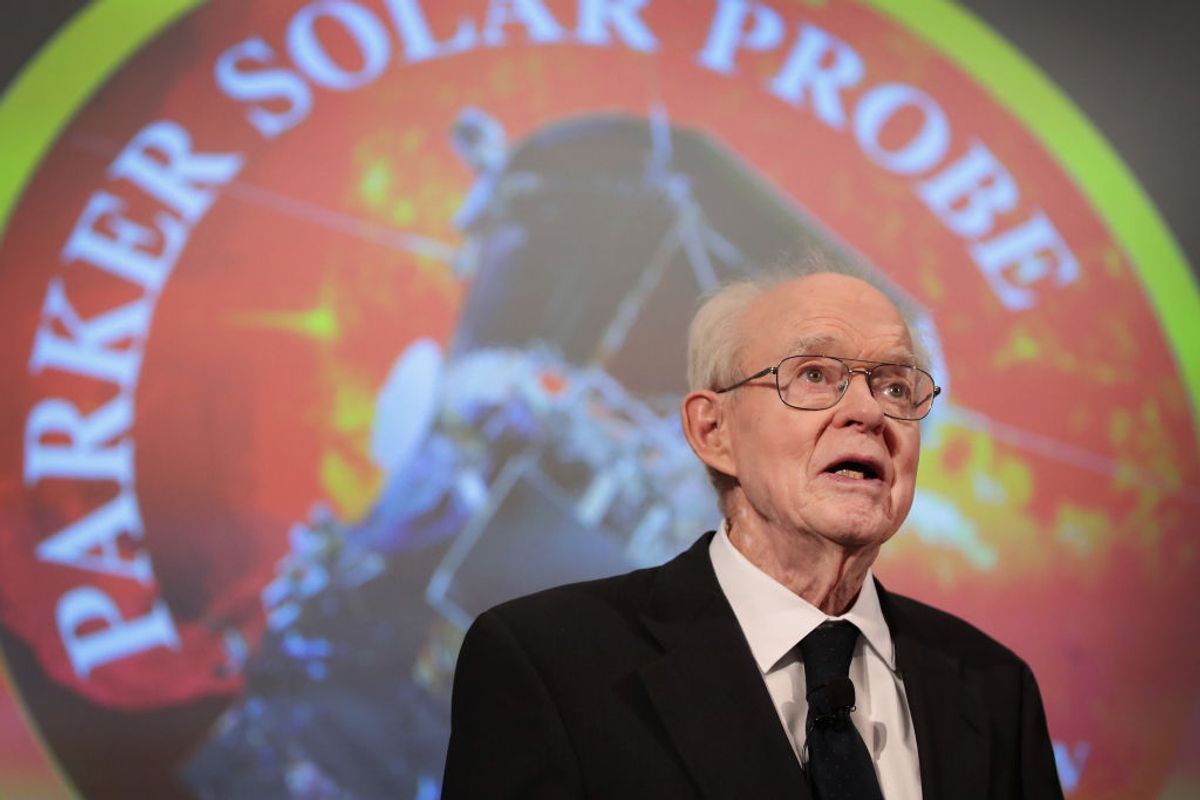
NASA has issued a warning about a pending “internet apocalypse” caused by a solar storm.

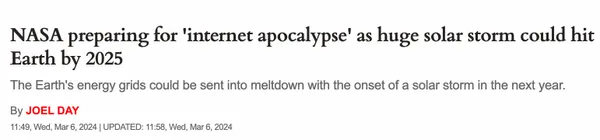
In early March 2024, the claim that NASA had issued a “warning” about an impending “internet apocalypse” — the persistent and global loss of the internet caused by a severe solar storm — went viral … again. In this case, most posts on social media appeared to have followed a March 6, 2024, story published by the U.K. tabloid Daily Express:
This was far from the first time this same claim has gone viral. Snopes first fact-checked it in 2023. In that case, a similarly-titled article in the U.K. tabloid The Mirror — which is owned by the same company behind the Daily Express — pushed the same claims to virality. That story and headline implied that NASA had used the term “internet apocalypse” and done so recently in a warning:
NASA Mission to Prevent ‘Internet Apocalypse’ Which Could Leave People Offline for Months
A groundbreaking mission by NASA’s Parker Solar Probe (PSP) has successfully ventured through solar wind for the first time aiming to prevent people on earth being unable to get on the internet.
Scientists have issued warnings about the potential impact of a solar storm, commonly referred to as an “internet apocalypse,” which could strike within the next decade.
Two sentences into that article, a reader may be left with the impression that NASA’s Parker Solar Probe (PSP) was designed to prevent the total collapse of the internet, and that a new development in that mission has raised fresh alarm about the likelihood of such a disruption. Strictly speaking, neither impression is correct.
NASA has reportedly launched mission to prevent potential ‘internet apocalypse’ that could halt online access for months and or even years. pic.twitter.com/FJ1MCXb5px
— Buzzing Pop (@BuzzingPop) June 23, 2023
While solar storms can, in theory and in extreme cases, cause widespread disruption to the internet and other communication tools, NASA has not issued a specific warning about such an event, nor has it ever officially referred to such an event as an “internet apocalypse.”
What Is the Parker Solar Probe?
The PSP, named “Space Probe Plus” during its development, has been in the works since 2010. As NBC News reported then, its “overall mission goals” were “to figure out the sun’s heating mechanism and determine how it whips up the solar wind — the continuous blast of charged particles that permeate the solar system and define its boundaries.”
While scientists have suspected or known about the existence of solar wind for decades, the mechanisms that create particularly high energy forms of solar wind and any methods that might predict such periods of intensity have long eluded scientists.
As NASA explained in 2018, part of the problem is that most of the information scientists had gathered to that date had come from spacecrafts or satellites closer to Earth, given the obvious technical challenges of sending highly technical electronic instrumentation into the metal-heating inferno of the Sun:
Parker Solar Probe […] will fly closer than any spacecraft before and uncover new secrets about our star. […] Right now, our only measurements of the solar wind happen near Earth, after it has had tens of millions of miles to blur together, cool down and intermix. Parker’s measurements of the solar wind, just a few million miles from the Sun’s surface, will reveal new details that should help shed light on the processes that send it speeding out into space.
Many of these processes are highly technical concepts unique to advanced heliophysics. However, heliophysics research and its funding is often justified, in part, on the basis of protecting Earth’s electrical and communication infrastructure in the event of a severe solar storm.
For example, the National Oceanic and Atmospheric Administration’s (NOAA) latest geostationary weather satellite, GOES-16, is frequently highlighted in public-facing promotional materials as a suite of tools designed to “enable NOAA’s Space Weather Prediction Center to issue space weather forecasts and provide early warning of possible impacts to Earth’s space environment and potentially disruptive events on the ground.”
The Parker Solar Probe is no different. A 2016 mission summary for the solar probe, published in the scientific journal Space Science Reviews, closed with the importance of the mission’s work in terms of protecting against those events:
SPP [Solar Probe Plus] is more than a fundamental physics mission. The physics of the corona and inner heliosphere connect the activity of the Sun to the environment and technological infrastructure of the Earth.
Events on the Sun drive the fundamental physics of the heliosphere, aurora, and magnetosphere of the Earth and other planets, affecting satellite communications, power grids, pipelines, radiation exposure on airline flights, and astronaut safety. […] Until we can explain the physical processes occurring close to the Sun, we will not be able to accurately predict space weather effects that can cause havoc at Earth.
In order to unlock the mysteries of the corona, but also to protect a society that is increasingly dependent on technology from the threats of space weather, we will send Solar Probe Plus to touch the Sun.
So while it is true that data from the PSP has the ability, in theory, to aid in our prediction of events that could disrupt communication systems, including the internet, the mission has a much broader set of goals than this one issue.
Further, NASA-funded research has highlighted the risk of an internet failure in response to solar wind heliophysics research for over a decade. The possibility was raised, for example, in a 2009 NASA news release about a study it funded on the risks of solar storms:
A NASA-funded study describes how extreme solar eruptions could have severe consequences for communications, power grids and other technology on Earth. The National Academy of Sciences in Washington conducted the study. […]
Besides emitting a continuous stream of plasma called the solar wind, the sun periodically releases billions of tons of matter called coronal mass ejections. These immense clouds of material, when directed toward Earth, can cause large magnetic storms in the magnetosphere and upper atmosphere. Such space weather can affect the performance and reliability of space-borne and ground-based technological systems.
Space weather can produce solar storm electromagnetic fields that induce extreme currents in wires, disrupting power lines, causing wide-spread blackouts and affecting communication cables that support the Internet.
Why Were We Talking About the Parker Space Probe In 2023?
The PSP has been heading toward or circling the sun and collecting data since its launch in 2018. The noteworthy item that brought the mission to the attention of outlets like The Mirror was a June 2023 news release from the Berkeley’s Physics Department about a just-released paper based on PSP data published in the high-impact scientific journal Nature.
In two introductory paragraphs, the release highlighted the scientific advancement presented in the paper (the detection of high-energy particles that match a theoretical concept hypothesized to create super high energy solar wind bursts), as well as its significance (these bursts, which we don’t fully understand, can be directed at Earth):
In a paper to be published this week in the journal Nature, a team of scientists led by Stuart D. Bale, a professor of physics at the University of California, Berkeley, and James Drake of the University of Maryland-College Park, report that the Parker Solar Probe has detected streams of high-energy particles that match the supergranulation flows within coronal holes, which suggests that these are the regions where the so-called “fast” solar wind originates.
Coronal holes are areas where magnetic field lines emerge from the surface without looping back inward, thus forming open field lines that expand outward and fill most of space around the sun. These holes are usually at the poles during the sun’s quiet periods, so the fast solar wind they generate doesn’t hit Earth. But when the sun becomes active every 11 years as its magnetic field flips, these holes appear all over the surface, generating bursts of solar wind aimed directly at Earth.
One of the major scientific disputes PSP was designed to resolve was the process by which extremely high-energy particles, ejected from the sun between 10 and 100 times faster than average solar wind, are created. There had been two competing theories, the news release explained, and this new data pointed clearly to one — magnetic reconnection:
“The big conclusion is that it’s magnetic reconnection within these funnel structures that’s providing the energy source of the fast solar wind,” Bale said. “It doesn’t just come from everywhere in a coronal hole, it’s substructured within coronal holes to these supergranulation cells. It comes from these little bundles of magnetic energy that are associated with the convection flows. Our results, we think, are strong evidence that it’s reconnection that’s doing that.”
A hard law in science journalism, sadly, is that many technical advancements, like a broader understanding of the role of supergranulation cells in fast solar wind, are simply not going to attract clicks the way that wholesale societal collapse would. Nowhere in the news release (which was not produced by NASA), did the words “internet apocalypse” appear. The same is true of the study the news release promoted.
Where Did the Term ‘Internet Apocalypse’ Come From?
For over a decade, “internet apocalypse” has been used to describe a broad array of things that could allegedly destroy the internet and/or society. A CNET article from 2010, for example, referenced the term “internet apocalypse” to describe the way some people viewed recently proposed net neutrality legislation.
The term was referenced in a New Yorker article in 2014 about a training scenario for a total loss of internet caused by things like “extreme weather [or] tyrannical governments.” The Verge used “Internet apocalypse” in 2016 in the context of a widespread DDOS attack — a form of hacking — that could render the internet useless.
As The Washington Post reported in June 2023, the term internet apocalypse in reference to a solar storm is a newer invention. The Post reported that this use was popularized in a 2021 paper by University of California, Irvine computer science Professor Sangeetha Abdu Jyothi — “Solar Storms: Surviving the Internet Apocalypse.” The paper received widespread attention thanks to a Wired article covering its findings.
The paper, which did not include or involve data from the PSP and that did not have any connection to NASA, “investigate[d] the impact of solar superstorms that can potentially cause large-scale Internet outages covering the entire globe and lasting several months.” In retrospect, she told the Post, she regrets using the term:
Jyothi says she has felt bad for using the term “internet apocalypse” in her paper. There’s not much ordinary people can do to prepare for such a phenomenon; it falls on governments and companies. And the paper “just got too much attention,” she said.
“Researchers have been talking for a long time about how this could affect the power grid,” she notes, “but that doesn’t scare people to the same extent for some reason.” Losing power also causes one to lose internet, of course.
NASA itself has never issued any warning about an “internet apocalypse,” but it has for well over a decade educated the public about the potential risk of a high-intensity solar storm.
A NASA Warning?
The only connection to NASA in the early June 2023 PSP viral stories was that the data was from a NASA mission and analyzed by researchers funded by NASA. This news cycle was spawned by a new understanding of energy flows from the sun. Nothing presented by these researchers was the discovery of any new risk not already considered by NASA.
Several articles using the “internet apocalypse” reference alleged suggestions made by NASA that the sun is about to enter a period of higher solar storm activity. While this is true, this is neither new information nor is it a discovery of the PSP. Science has been aware of these roughly 11-year cycles for centuries. As NASA reported in 2020, the minimum activity point that marked the end of the last cycle occurred in December 2019:
The solar minimum between Solar Cycle 24 and 25 – the period when the sun is least active – happened in December 2019, when the 13-month smoothed sunspot number fell to 1.8, according to the Solar Cycle 25 Prediction Panel, co-chaired by NOAA and NASA. We are now in Solar Cycle 25 with peak sunspot activity expected in 2025, the panel said.
“While we are not predicting a particularly active Solar Cycle 25, violent eruptions from the Sun can occur at any time,” [NOAA Scientist Doug] Biesecker added in that report. That the maximum of this next cycle would occur in or around 2025 is a fact that has been known for a long time. NASA’s acknowledgement of such cycles does not constitute a warning.
Snopes can identify only one reference to “internet apocalypse” on an official NASA website — in the text caption of an April 2023 archive image from High Energy Astrophysics Science Archive Research Center showing a recently decommissioned heliophysics satellite, whose description linked to the aforementioned Wired article when referencing the term:
Our interconnected civilization could be brought to its knees by a solar flare, which could do serious harm to our electronically-dependent communications networks, perhaps even causing an “internet apocalypse”, lasting days, weeks, or even longer.
Keeping an eye on the Sun’s erratic, high-energy behavior was the job of the Reuven Ramaty High Energy Solar Spectroscopic Imager, or RHESSI. RHESSI, pictured above […].
This retrospective look at an old satellite is certainly not an active warning of an internet apocalypse, nor can it possibly be related to a news story about a different mission. Outside of this one example, no evidence exists to suggest that NASA officially uses the term, let alone used it in a recent warning.
The Bottom Line
The physics underlying claims that a massive solar storm could disrupt internet communications is uncontroversial and — if one compares telegraph lines to the internet — has historical precedent. Clickbait headlines, however, have cast this alarming but long-known reality about solar storms as a recent discovery of a present NASA mission.
That mission did make significant discoveries about our knowledge of solar flares, but it did not provide any data suggesting a new urgency to the potential telecommunication problems caused by them. Because NASA never issued any warning about pending solar storm activity and because it never used the term “internet apocalypse” to describe its danger, we rate this claim as “False.”
Sources
“10 Things to Know About Parker Solar Probe.” NASA Solar System Exploration, https://solarsystem.nasa.gov/news/522/10-things-to-know-about-parker-solar-probe. Accessed 30 June 2023.
A Super Solar Flare | Science Mission Directorate. https://science.nasa.gov/science-news/science-at-nasa/2008/06may_carringtonflare. Accessed 30 June 2023.
Ables, Kelsey. “Is the ‘Internet Apocalypse’ Nigh? Breaking down the Solar-Storm Science.” Washington Post, 28 June 2023, https://www.washingtonpost.com/technology/2023/06/28/solar-storm-internet-apocalypse/.
Bale, S. D., et al. “Interchange Reconnection as the Source of the Fast Solar Wind within Coronal Holes.” Nature, vol. 618, no. 7964, June 2023, pp. 252–56. www.nature.com, https://doi.org/10.1038/s41586-023-05955-3.
Burrington, Ingrid. “The Internet Apocalypse Map Hides the Major Vulnerability That Created It.” The Verge, 24 Oct. 2016, https://www.theverge.com/2016/10/24/13380448/ddos-dyn-attack-internet-infrastructure.
Debunking the Internet Apocalypse – CNN.Com. http://www.cnn.com/2010/TECH/web/08/17/cnet.internet.apocalypse/index.html. Accessed 30 June 2023.
Fox, N. J., et al. “The Solar Probe Plus Mission: Humanity’s First Visit to Our Star.” Space Science Reviews, vol. 204, no. 1, Dec. 2016, pp. 7–48. Springer Link, https://doi.org/10.1007/s11214-015-0211-6.
Kopfstein, Janus. “How to Survive an Internet Apocalypse.” The New Yorker, 11 Apr. 2014. www.newyorker.com, https://www.newyorker.com/tech/annals-of-technology/how-to-survive-an-internet-apocalypse.
NASA – NASA-Funded Study Reveals Hazards of Severe Space Weather. https://www.nasa.gov/topics/solarsystem/features/spaceweather_hazard.html. Accessed 30 June 2023.
Newman, Lily Hay. “A Bad Solar Storm Could Cause an ‘Internet Apocalypse.'” Wired. www.wired.com, https://www.wired.com/story/solar-storm-internet-apocalypse-undersea-cables/. Accessed 30 June 2023.
—. “A Bad Solar Storm Could Cause an ‘Internet Apocalypse.'” Wired. www.wired.com, https://www.wired.com/story/solar-storm-internet-apocalypse-undersea-cables/. Accessed 30 June 2023.
Parker Solar Probe Flies into the Fast Solar Wind and Finds Its Source | Physics. https://physics.berkeley.edu/news/parker-solar-probe-flies-fast-solar-wind-and-finds-its-source. Accessed 30 June 2023.
“Space Weather Instruments.” GOES-R.Gov, https://www.goes-r.gov/education/docs/Spaceweather.pdf.
“Spacecraft to Fly into the Sun.” NBC News, 6 Sept. 2010, https://www.nbcnews.com/id/wbna39024291.
Stacy, Kendra. “NASA Warns of ‘Internet Apocalypse’ That May Leave People Without Connection for Months; Parker Solar Probe Tries To Prevent This From Happening.” Science Times, 25 June 2023, https://www.sciencetimes.com/articles/44505/20230625/nasa-warns-internet-apocalypse-leave-people-without-connection-months-parker.htm.
US Department of Commerce, NOAA. Hello Solar Cycle 25. https://www.weather.gov/news/201509-solar-cycle. Accessed 30 June 2023.
Williamson, Lucy. “NASA Warns of ‘internet Apocalypse’ Which Could Leave People Offline for Months.” Mirror, 7 June 2023, https://www.mirror.co.uk/news/us-news/nasa-spacecrafts-mission-prevent-internet-30178328.
“About Us.” Express.Co.Uk, https://www.express.co.uk/about-us. Accessed 8 Mar. 2024.
“About Us – Mirror Online.” The Mirror, https://www.mirror.co.uk/about-us/. Accessed 8 Mar. 2024.
Day, Joel. “NASA Preparing for ‘internet Apocalypse’ as Solar Storm Could Hit Earth by 2025.” Express.Co.Uk, 6 Mar. 2024, https://www.express.co.uk/news/science/1874263/nasa-internet-apocalypse-solar-storm-spt.
