

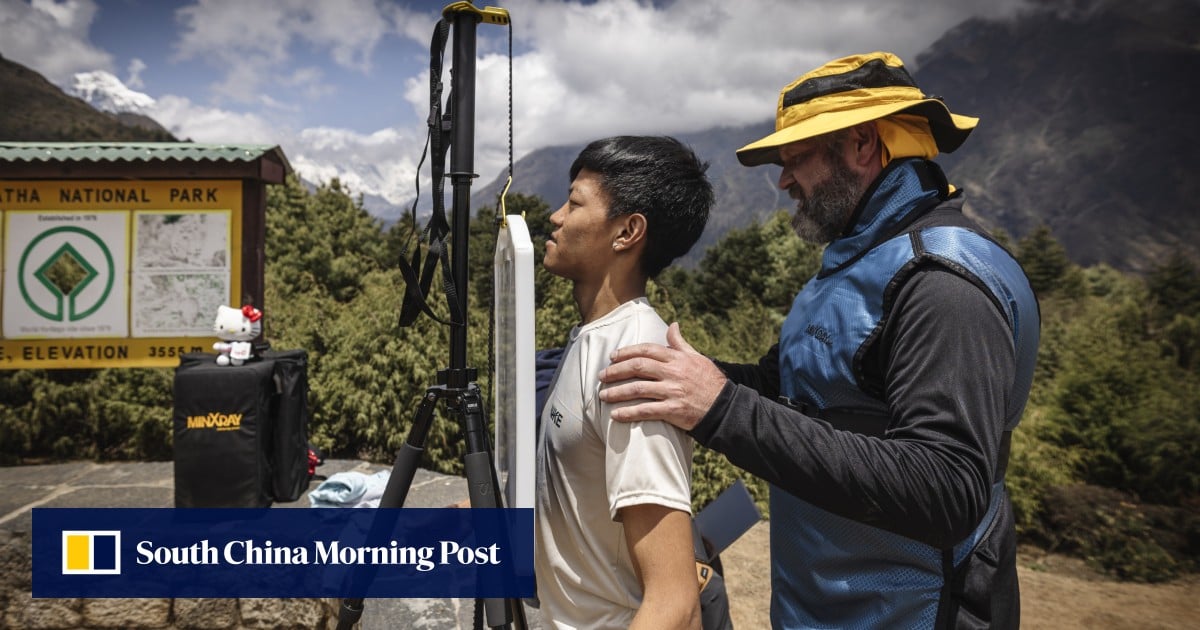
A group of medical experts considered May’s expedition a success. Their goal was to demonstrate that a portable, AI-powered X-ray machine (weighing about 25 kg) can work in one of the most remote places in the world. The technology, already commercially viable around the world, is considered key to eradicating tuberculosis (TB), a major health problem in many developing countries.

Mikkel Broholt, operations manager for Stop TB and expedition member, says many people with TB go undetected and are at risk of unknowingly spreading the disease.
“To eliminate TB we need to test many more people, and if we can take an X-ray machine to the top of a Himalayan mountain, we can take it anywhere,” Broholt says.
AI has long held promise for making healthcare more accessible, with chatbots in automated management systems helping to free up valuable time for doctors and nurses.
Karen DeSalvo, Google’s chief health officer, likens AI to the discovery of penicillin.
This is “the most transformative opportunity of our lifetime to advance human health,” she told the World Health Assembly in Geneva in June, where AI was one of the hottest topics at the annual gathering of the world’s health elite.
At the event, DeSalvo described a future in which “geography, socioeconomic status, race, ethnicity and resource limitations no longer influence health outcomes.”
One of the first AI applications to hit the market in healthcare is computer-aided diagnosis, with such tools already being used for triage and preliminary testing in some developed countries.
The technology is also being increasingly adopted in developing countries, where a shortage of radiologists means AI is expected to revolutionize healthcare services.

Pasang Yanji, 63, wakes up on a heavy wooden bench in a hospital waiting room in Lukla, Nepal. Because she has tuberculosis, she falls asleep easily and often stays asleep for long periods of time.
“I come here every day for treatment,” she said in a barely audible voice.
Here in the high-altitude eastern Khumbu district, coughing is so common that it has been dubbed the “Khumbu cough.” Coughing is often caused by dry, oxygen-poor air, and some locals suffer from more severe respiratory illnesses. Taking age into account, Nepal has one of the world’s highest rates of chronic lung disease, according to a study published in the peer-reviewed medical journal BMJ in 2022.
Pasang Yanji contracted tuberculosis from her husband in 2017 and underwent treatment for two months, but felt that her daily visits to the hospital were interfering with her work. Until three months ago, she had stopped going to the hospital and continued working even though she had a persistent cough.
She then resumed treatment as her symptoms worsened.
Stop TB’s Broholt recognizes the pattern.
“Doctors we spoke to said there aren’t many cases of TB, but acknowledged that this may not reflect reality because there is no testing or diagnostic access.”

According to 2022 World Health Organization (WHO) data, the rugged Khumbu has just one doctor for every 150,000 inhabitants, well below the global density of 17 doctors per 10,000 people.
Tests require patients to travel to Kathmandu, which is expensive and often takes so long that they risk losing their jobs. Even in the capital, resources are scarce: There are just 150 radiologists in a country of 29 million who can analyze X-ray images.
“With the help of new technologies such as ultra-portable x-rays powered by AI, we can test people quickly and determine which cases are normal and which are abnormal,” Broholt said. “Not only will this eliminate the need to travel to larger cities, but TB testing will also be less dependent on highly trained medical personnel.”
Stop TB is working with companies around the world to pilot on-site tests, and in Nepal it has partnered with healthcare AI developer Qure.ai, whose tools received a major boost during the pandemic as they were used to diagnose COVID-19 cases around the world.
“It was also a time when people were beginning to accept and expect shorter trips. [distance] “Hospitals started coming to us for care. During COVID, hospitals started coming to us,” Qure.ai CEO Prashant Warrier said. “Since then, we’ve grown 10x.”

Qure.ai currently sells its tools to hospitals in several developed countries, but Warrier said the company’s goal has always been to help people living in remote and impoverished areas.
“We started in Mumbai, a city with some of the poorest and most densely populated communities in the world. AI can solve pressing health challenges not only here but in many parts of the world.”
Early adoption of AI tools will enable the scaling of new technologies in emerging markets, Warrier said, adding that in the future, AI could become as ubiquitous as mobile payments.
“Today you can live cash-free anywhere in India, but that’s not the case in many other parts of the world,” Warrier said.
Stop TB, an international partnership run by the UN Department of Project Services, has been rolling out AI-enabled portable X-ray machines to several countries over the past few years, and the technology has already been used to screen hundreds of thousands of people, detecting tens of thousands of abnormalities in chest X-rays in the process.
Broholt is excited that the technology will soon be ready for large-scale deployment.
“Tuberculosis is the world’s deadliest infectious disease and disproportionately affects vulnerable groups. AI represents an opportunity to invest in health equity.”
In Nepal, Broholt and his team have donated X-ray machines to local hospitals and are training medical workers there how to use them to screen for tuberculosis, mainly in the chest, but also for other injuries.
“It’s now a question of resources and political will to further development.”

AI has the potential to bring many breakthroughs to medicine, but hurdles remain, and the WHO has been working for years to develop standards to ensure the quality and safety of new technologies.
“Countries and regions need to be able to evaluate the different solutions that are on offer,” said Alain Labric, WHO’s director of digital health innovation.
This Week in Asia spoke to medical experts who expressed frustration at the slow adoption of AI tools, and Labric said he understood their feelings but warned against hasty adoption.
“New areas such as digital health and AI, if not implemented properly or without proper oversight, could erode public trust, further slowing adoption and reducing impact,” Labric said.
The WHO has released a toolkit for harnessing new X-ray technology and has frequently cited it to highlight the potential of AI in medicine.
Sitting in a hospital waiting room in Lukla, Nepal, Pasang Yanji feels uncomfortable and tired, but she smiles calmly. “I’m looking forward to living a normal life again,” she says.
