


Nvidia went all out at this year’s GPU Technology Conference (GTC), showing off its next-generation Blackwell AI platform. This beast is set to significantly power large-scale language modeling and generative AI workloads. But that’s not the only thing they worked hard on. Let’s take a look at the highlights.
The star of the show was Nvidia’s new Blackwell GPU. This is a large-scale AI accelerator consisting of two GPUs working together on a single package. It’s like a double-chip monster that can handle the most difficult generative AI tasks without breaking a sweat.
But it’s not just raw power. Nvidia says Blackwell can achieve up to 30x more inference throughput and 4x more training performance compared to his previous H100 GPU, all while using less energy. . This is thanks to a number of cool technologies, including a second-generation transformer engine that supports FP4 accuracy and an ultra-fast decompression engine.

Nvidia didn’t stop there. They also put Blackwell GPUs into his 3-die “superchip” called the GB200. This chip combines his two Blackwell GPUs and Grace Arm CPU to create an extremely powerful AI processor.
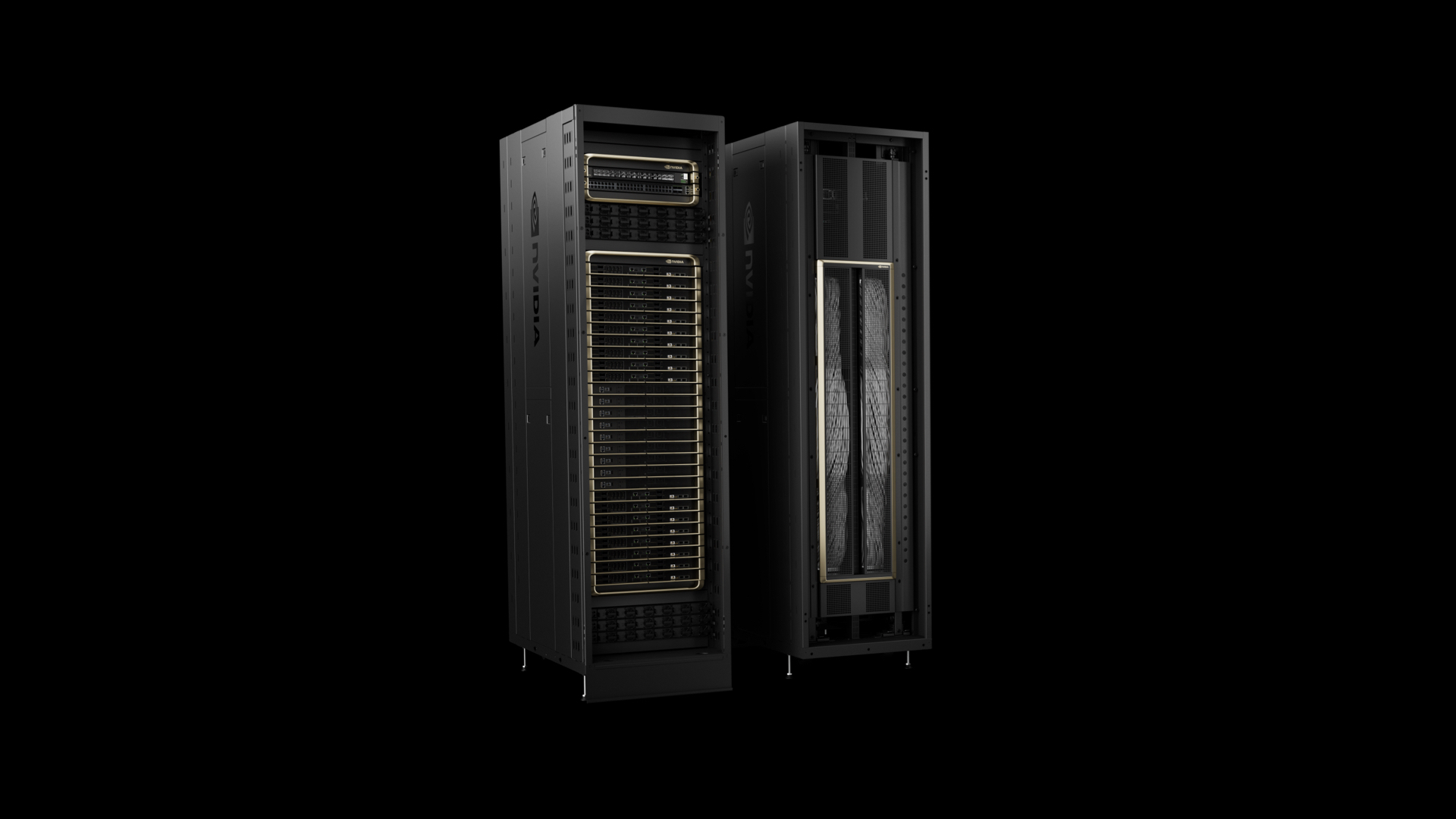
These GB200 superchips are packed into the NVL72 rack, an AI powerhouse with 72 Blackwell GPUs and 36 Grace CPUs. Nvidia says this single rack can train models with up to 27 trillion parameters, allowing enterprises to tackle their biggest generative AI challenges.


The impact of Blackwell’s performance could be significant. Nvidia believes this could lead to breakthroughs in everything from data processing and engineering simulation to electronic design automation, computer-aided drug design, and quantum computing.
Nvidia isn’t the only company excited about Blackwell. Big tech companies are already helping with this, including Amazon, Google, Meta, Microsoft, OpenAI, Oracle, and Tesla.
DGX Super Pod


Nvidia also announced new versions of its DGX AI system and SuperPOD rack-scale architecture to take full advantage of Blackwell. His DGX GB200 system, which uses the GB200 superchip, promises 15x better inference performance and 3x training speeds compared to his previous DGX H100 system. Inference is running live data through machine learning algorithms to obtain output.
The new liquid-cooled SuperPOD architecture built on the DGX GB200 system delivers an incredible 11.5 exaflops of AI computing power with FP4 accuracy and massive 240 terabytes of high-speed memory per rack. This level of performance is designed to meet the demands of the most complex AI models and workloads.
Deepening cloud AI collaboration with Google and AWS
At the GTC event, Nvidia also highlighted expanding partnerships with cloud giants Google and Amazon Web Services (AWS). Google announced it will adopt the Grace Blackwell AI computing platform and her NVIDIA DGX Cloud services to power its generative AI capabilities.
The companies will also collaborate on open model optimizations such as Gemma, support for JAX on Nvidia GPUs, and use of Nvidia’s NIM inference microservices, giving developers a flexible and open way to train and deploy AI models. provide a platform.
NIM concept announcement
One of the most interesting announcements at GTC was Nvidia’s Inference Microservices (NIM) concept. NIM is designed to help customers easily deploy generative AI applications in a secure, stable, and scalable manner. It is part of Nvidia AI Enterprise and includes prepackaged AI models, integration code, and preconfigured Kubernetes Helm charts for deployment.
NIM accelerates time to market for AI deployments, allowing developers to get models up and running in as little as 10 minutes.
Project GR00T

Nvidia also unveiled Project GR00T (Generalist Robot 00 Technology), an exciting initiative aimed at developing a generalist basic model for humanoid robots. Project GR00T aims to enable robots to understand natural language, see and imitate human movements, and rapidly acquire skills such as coordination, dexterity, and real-world navigation. Nvidia CEO Jensen Huang showed off several of his GR00T-powered robots performing various tasks, showing what the project could do.
Coinciding with Project GR00T is Jetson Thor, a new computer designed specifically for humanoid robots built on Nvidia’s Thor system-on-chip (SoC).
6G research platform
Nvidia also demonstrated a commitment to advancing cutting-edge technologies such as 6G wireless and industrial digital twins. The company announced its 6G Research Cloud platform, which will help researchers develop the next stage of wireless technology and lay the foundation for a super-smart world.
Omniverse gets new API

Nvidia also announced the availability of Omniverse Cloud APIs, expanding the scope of the Omniverse platform for creating industrial digital twin applications and workflows. This will enable software manufacturers to easily integrate Omniverse technology into their existing design and automation software, accelerating the adoption of digital twins across industries.
Thor SoC expands footprint
Finally, Nvidia’s GTC event highlighted the company’s growing presence in the automotive industry. Several automakers, including BYD, Hyper (a GAC Aion company), and Xpeng, have announced plans to use Nvidia’s Drive Thor system-on-chip (SoC) in their future electric vehicle fleets.
Drive Thor promises unprecedented 1,000 teraflops of performance while reducing overall system costs, allowing automakers to combine autonomous driving, in-cabin AI, and infotainment systems on a single platform. Can be combined.
