



A total of 231 WiFi hotspots were connected in the 2023/24 financial year.
The Ministry of Communications, through its entity Broadband InfraCo (BBI), connected 231 community WiFi hotspots in various local governments in the 2023/24 financial year.
This is despite an announcement to roll out around 10,000 WiFi hotspots across the country during the period under consideration.
In his budget vote speech last year, Communications Minister Mondli Gungubele unveiled his ministry’s plans to deploy 9,900 hotspots in 16 districts across the country, with the goal of reaching 80% connectivity by 2024.
Mr Gungubele said this in response to a question from Democratic Alliance MP Tsholophelo Motsidi Bodlani on progress in expanding WiFi access across the country, as set out in his speech. Municipality of the district. ”
According to the minister’s response, KwaZulu-Natal is the province with the most WiFi hotspots, followed by Gauteng. Connected hotspots are also located in the Eastern Cape, Free State and Limpopo.
Analysis by mobile analytics company Opensignal reveals that most rural areas in South Africa rely solely on mobile services to connect to the internet.
Statistics show that around 80% of SA households remain without access to fast and affordable broadband internet. Only about 10% of the population has access to internet connectivity via fiber or fixed wireless access.
To close the connectivity gap in the country, the government is betting on SA Connect, an ambitious national broadband project, with support from state-owned bodies such as the BBI and state IT agencies.
SA Connect aims to ensure universal access to broadband services for all South Africans, with priority given to rural and underserved areas.
Phase 1 of SA Connect was aimed at connecting government facilities and phase 2 of the project was aimed at providing continuous internet access.
The government launched phase two in November. It is intended to provide the core and access network infrastructure that enables broadband connectivity to community WiFi hotspots that connect homes.
The 2023 medium-term budget policy statement showed that the Department of Communications and Digital Technologies (DCDT) has revised its targets for the second stage downward.
According to the Adjusted National Expenditure Estimates (AENE) document, DCDT is currently considering connecting 882,000 households as part of its broadband plan for the 2023/24 financial year.
This is below the projected target of 1.9 million households published in the 2023 National Expenditure Estimates (ENE). ENE revealed that the ministry is targeting a further 3.8 million households to be connected during the 2024/25 financial year.
AENE said the change in targets for the 2023/24 financial year was due to delays in its governance structure. “This delayed the disbursement of funds and reduced the budget.”
The AENE is a document released in conjunction with Finance Minister Enoch Godongwana’s 2023 Medium-Term Budget Policy Statement, which was presented in Parliament in November.
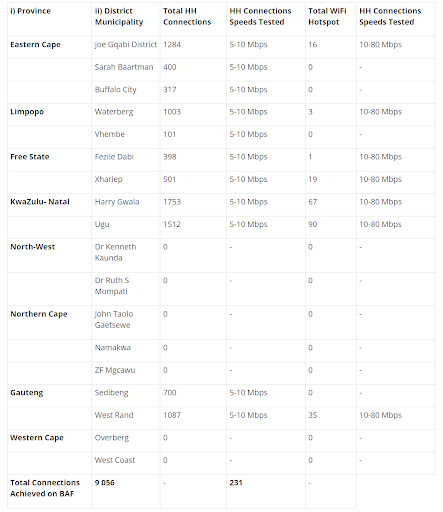
List of district municipalities with WiFi hotspots connected by the communications department.
