

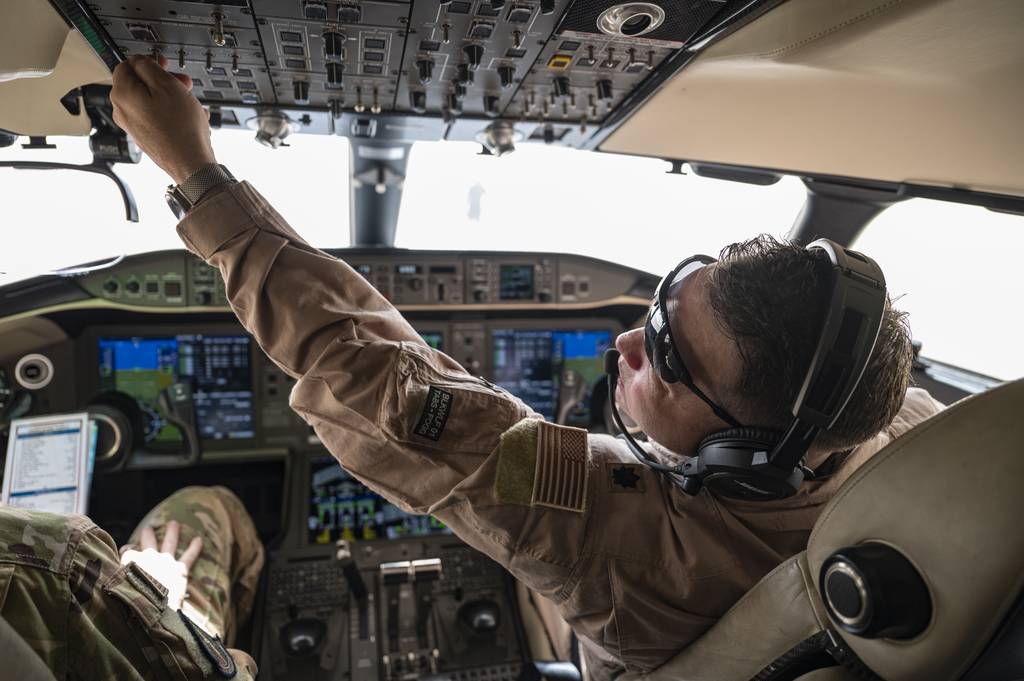
The Air Force’s E-11A airborne communications repeater aircraft has been dubbed the “WiFi of the sky” because of its ability to share battlefield data with aircraft and ground forces far away, including in the mountainous terrain of Afghanistan.
The aircraft, a modified Bombardier business jet fitted with a Northrop Grumman Battlefield Airborne Communications Node (BACN), is lesser known than the Air Force’s workhorse bombers, fighters, and cargo planes. Now, with U.S. troops withdrawn from Afghanistan, the E-11 has a new behind-the-scenes role supporting the multinational mission delivering humanitarian aid to the Gaza Strip.
Related
:quality(70)/cloudfront-us-east-1.images.arcpublishing.com/archetype/ETDSAPNUCVH7VBHVOJLX5763VM.jfif)
Since March, the 430th Expeditionary Electronic Combat Squadron, the only Air Force unit to fly the aircraft, has supported more than 30 airdrops in Gaza from U.S. Central Command, operating from an undisclosed location. Pilots with the squadron who spoke to Air Force Times did not discuss specific missions but spoke briefly about their activities in the region.
The Air Force has participated in 40 airdrops with coalition forces since March. Those missions were suspended for more than a month when Israel launched its invasion of the city of Rafah in early May. The U.S. military conducted its most recent airdrop on June 9.
“The BACN mission provides the Air Force, and our joint and international partners, with line-of-sight and beyond-line-of-sight interoperability – interoperability between different platforms with a variety of electronic capabilities,” said Lt. Col. R. Clayton “Vector” McCart, 430th EECS commander. “We capture, convert, combine and ultimately relay and extend legacy and modern communications and data links.”
That could mean alerting cargo planes transporting food of potential threats, course corrections or other important details from mission planners or other forces around the area.
In a vast area like CENTCOM, an airdrop can be aborted due to a variety of factors, from weather to flight safety concerns. With two pilots aboard, the BACN aircraft can rapidly relay real-time changes coming from the Joint Air Operations Center in Qatar to mission partners on the front line.
“We can monitor progress in ways that we can’t see on other platforms … in terms of asset location, weather forecasts and so on. Weather is a big factor in airdrops off the coast of Gaza,” said Capt. Briton “Rad” Ellington, an E-11A pilot who previously flew the retired E-8C Joint Surveillance Target Attack Radar System (JSTARS) aircraft.
With a range of more than 6,900 miles and a typical sortie time of about 10 hours, the aircraft can take over where satellite phones don’t work and interpret communications between the military’s myriad communication systems that normally can’t be connected. AFCENT did not disclose how many of the Air Force’s seven E-11As are in theater, but the 430th serves as a data release pad, logging more than 1,000 hours every two weeks.
“We’re not limited to airdrops. We can, for example, conduct airdrops as part of a larger expectation from Central Command leadership and move around the battlefield. … We’re not really tied to a specific location,” McCart said.
The E-11A is being prepared for its new home at the 18th Airborne Command and Control Squadron at Robins Air Force Base, Ga. This is one of four missions that will replace JSTARS aircraft at Robins over the next few years, with the squadron scheduled to be fully operational by 2027.
The 430th EECS, which is deployed from the Middle East and also serves as a training unit, will move its training mission to Robbins Island.
“Every sortie is a training sortie in the sense that you learn every time you fly,” McCart said.
Courtney Mabeus Brown is a senior reporter for Air Force Times. She is an award-winning journalist who previously covered the military for Navy Times and The Virginian-Pilot in Norfolk, Virginia, where she served aboard her first aircraft carrier. Her work has also appeared in The New York Times, The Washington Post, Foreign Policy, and more.
