


A Japanese telecommunications group has developed high-speed 6G wireless equipment that can transmit data up to 20 times faster than 5G.
The device can transmit data at 100 gigabits per second (Gbps) over distances of up to 330 feet (100 meters).
For this project, a consortium consisting of NTT, NEC, and Fujitsu has formed and is working together on research and development of sub-terahertz devices, with an eye on the arrival of the 6G era from 2021.
The tests achieved “ultra-fast 100Gbps transmission in the 100GHz and 300GHz bands at distances of up to 100 meters,” the companies said in a statement.
Frequency Frontier Challenges
The main difference between 5G and 6G is the frequency range of the electromagnetic spectrum that 5G and 6G operate in. The higher the bands they operate in, the faster the speeds will typically be.
5G transmissions are typically broadcast on frequencies below 6 GHz, expanding into the roughly 40 GHz band known as the “mmWave” band.
However, 6G is expected to use a high-frequency band between 100 and 300 GHz known as the “sub-terahertz” band.
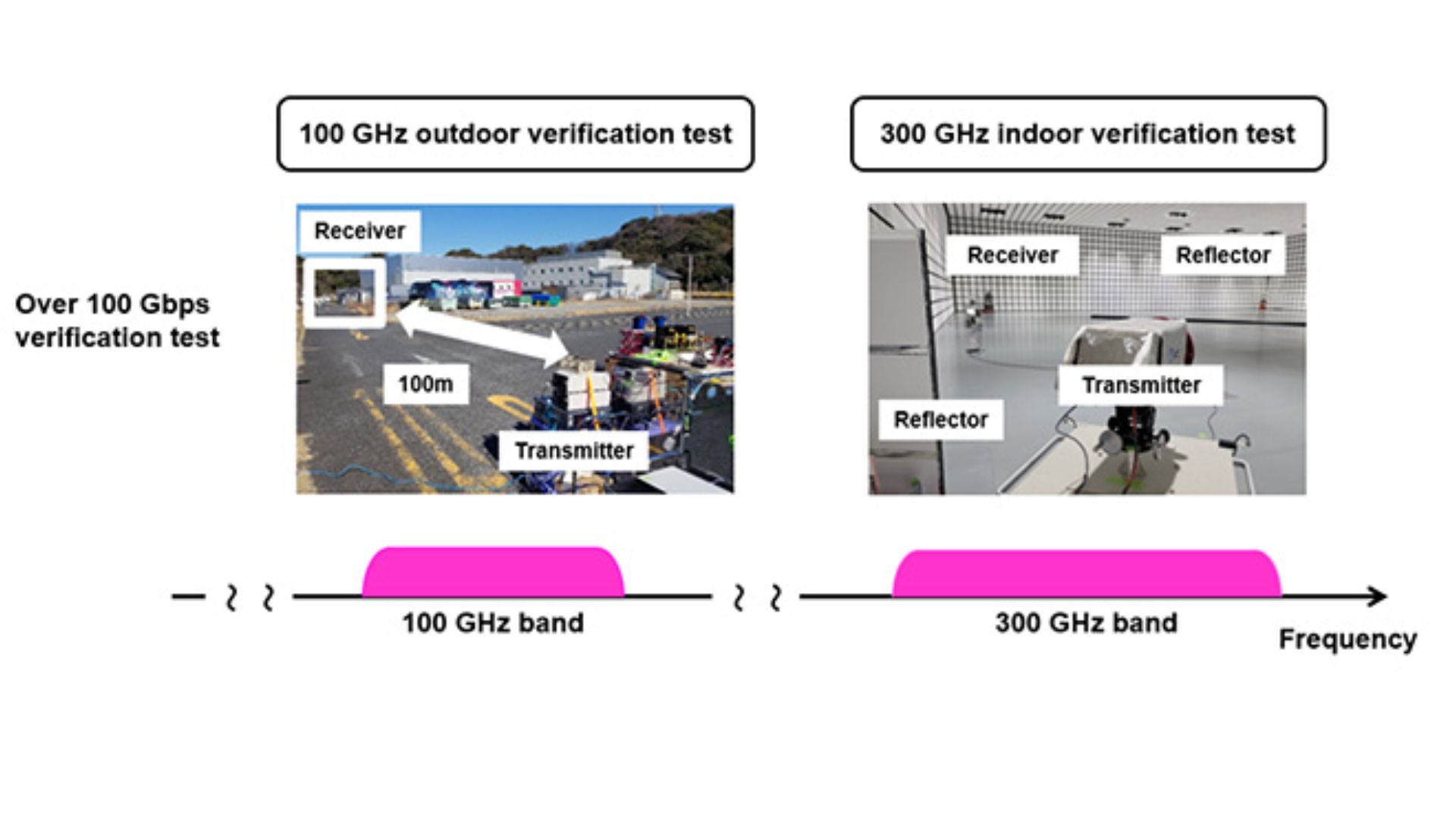
The significantly higher frequencies in the sub-terahertz band require radio devices that are completely different from the 28 GHz and other millimeter wave bands used in existing 5G systems, and development is currently being carried out from the ground up.
The companies say that for the project to be successful, they will need to overcome several major hurdles, including understanding the exact performance standards that wireless devices operating in the sub-terahertz frequency band must meet and then actually building such devices.
Pioneering sub-terahertz technology
Each of the four participating companies has made significant contributions to the advancement of sub-terahertz technology toward the realization of high-speed 6G devices.
DOCOMO thoroughly analyzed radio system configurations for 100 GHz communications applications and designed radio transmission equipment capable of achieving data rates of up to 100 Gbps within a range of 100 meters.
NTT has been developing high-end wireless equipment while focusing on the 300 GHz band, and has developed top-of-the-line 300 GHz band wireless equipment capable of transmitting 100 Gbps per channel over a distance of 100 meters.
NEC has committed resources to researching wireless system solutions specific to the 100 GHz band, and the project has resulted in the development of a complex multi-element active phased array antenna (APAA) with over 100 antenna elements.
Fujitsu has focused on developing new compound semiconductor technologies, achieving technological innovation that enables high-efficiency, high-output amplification of signals in the 300 GHz and 100 GHz bands.
In particular, the adoption of a high-output amplifier has achieved the world’s highest power efficiency, which is essential for extending communication distances and reducing power consumption.
The development of this advanced 6G technology has huge implications: the capacity achieved will be equivalent to wirelessly streaming five HD movies per second, opening up a wide range of potential uses for data transfer speeds.
Experts emphasize that providing seamless connectivity for future technologies will enable a variety of applications ranging from ultra-high definition video streaming to real-time control of autonomous vehicles, along with increasing communication demands – the possibilities are endless.

Get the latest news in engineering, technology, space and science with The Blueprint.
By clicking sign up, you agree to this site’s Terms of Use and Privacy Policy.
About the Editor
Jijo Marail Jijo is an automotive and business journalist based in India. He holds a BA (Hons) in History from St. Stephen’s College, University of Delhi and a Postgraduate Diploma in Journalism from the Indian Institute of Mass Communication, Delhi. He has worked for news agencies, national newspapers and automotive magazines. In his spare time, he enjoys off-roading, political debates, travelling and teaching languages.
