

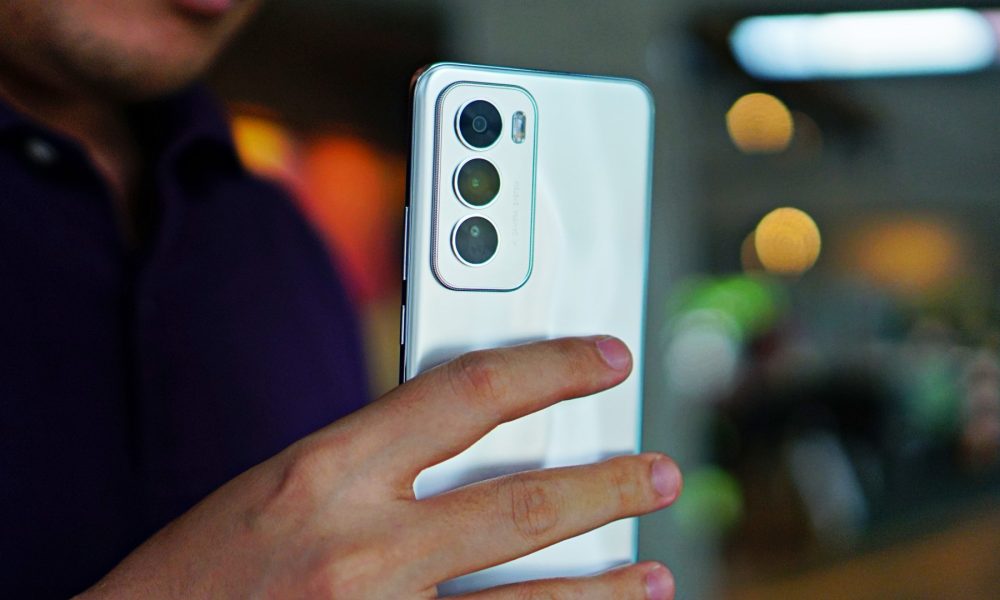
Three-way is never easy to achieve, but here it is. We took the Samsung Galaxy Z Fold6, the HONOR Magic V2 RSR, and the OPPO Find N3 (basically a OnePlus Open) around Paris to see how their cameras stack up against each other.
In case you haven’t noticed yet, all three are foldables. The Magic V2 and Find N3 are technically 2023 models, but those are the ones I have on hand right now. And the Z Fold6 has essentially the same camera as the Z Fold5. But since this is the first time I’ve had all three at the same time, I thought it’d be a good idea to compare them.
The specifications of each camera are as follows:

| Galaxy Z Fold 6 | Magic V2 RSR | Find N3 | |
| Main camera | 50 MP, f/1.8, 23mm (wide), 1.0µm, Dual Pixel PDAF, OIS | 50 MP, f/1.9, (Wide), PDAF, 8×8 dToF Laser AF, OIS | 48 MP, f/1.7, 24mm (wide), 1/1.43″, 1.12µm, Multi-directional PDAF, OIS |
| Telephoto | 10 MP, f/2.4, 66mm (telephoto), 1.0µm, PDAF, OIS, 3x optical zoom | 20 MP, f/2.4, 62mm (telephoto), PDAF, 2.5x optical zoom, OIS | 64 MP, f/2.6, 70mm (telephoto), 1/2.0″, 0.7µm, PDAF, OIS, 3x optical zoom |
| Ultra Wide | 12 MP, f/2.2, 123˚, 12mm (ultra-wide), 1.12µm | 50 MP, f/2.0, 13mm (ultra-wide), AF | 48 MP, f/2.2, 14mm, 114˚ (Ultra Wide), 1/2.0″, 0.8µm, PDAF |
| Selfie | 4 MP, f/1.8, 26mm (wide), 2.0µm, under-display | 16 MP, f/2.2, (Wide) | 20MP, f/2.2, 20mm (ultra-wide), 1/4.0″, 0.7µm |
| cover camera | 10 MP, f/2.2, 24mm (wide), 1/3″, 1.22µm | 16 MP, f/2.2, (Wide) | 32MP, f/2.4, 22mm (ultra-wide), 1/3.14″, 0.7µm |
The main cameras of these three phones are not that different. For the remaining cameras, things get a bit choppy. The OPPO Find N3 boasts the highest megapixel count of the three phones. But as you know, these hardware numbers aren’t everything.
All of these phones have been using “computational photography” for a while now – essentially AI to make the end product look a certain way – and it’s this post-processing that each phone applies that’s where the real differences lie.
A few more differences
The differences between these three cameras aren’t just in post-processing and megapixel counts – their form factors, especially when folded, are also very different, making for an interesting shooting experience.

The Galaxy Z Fold6 is the easiest to handle when shooting due to its tall and slender body, followed by the short and chunky OPPO Find N3, and the flattest and most difficult of the three to shoot with, the HONOR Magic V2. It’s not completely unwieldy overall, just compared to the other two foldable smartphones.
The HONOR Magic V2 also has a quirk in that it can’t capture images in 16:9 or 9:16 aspect ratios, so we stuck mostly to 4:3 or 3:4 in our samples. It’s also the only one of the three with a maximum optical zoom of 2.5x instead of 3x; we had to go up to 3x for semi-zoomed-in shots to keep the focal length looking the same.
Ok, enough already, if you came here to see the comparison, here you go.
Disclaimer: All photos were taken in auto mode with AI scene detection on (unless otherwise noted). These images have been collaged, resized, and labeled for faster loading and better previews. No color correction, enlargement cropping, or other photo manipulation has been applied.
Wide (1x)
W1

W2

W3

📍Notre Dame Cathedral
W4

W5

W6

W7

W9

W10

W11

📍Moulin Rouge
W12

W13

Ultra Wide (UWA)
You 1

U2

You 3

Zoom (3x)
This is the focal length I use most often for shooting, especially when I’m out and about, so it has the largest sample size.
Z1

📍Louvre Museum
Z2

Z3

Z4

📍Notre Dame Cathedral
Z5

Z6

The owner asked me to move it in the third shot so it doesn’t match perfectly✌️😅
Z7

Z8

📍Moulin Rouge
Z9

Z10

Z11

Z12

Z13

Z14

Z15

Bonus Zoom Shots (including 10x)
To better illustrate the difference between ultra-wide, wide and zoom shots, take a look at the following examples. These were taken directly underneath the Arc de Triomphe. Fun fact: underneath the Arc de Triomphe Unknown Gravewn Soldier It was from World War I. To this writer’s gamer sense, it sounded like the location of a boss fight, or perhaps an important relic.
BZ1

Ultra Wide
BZ2

1x zoom
BZ2

3x zoom
BZ4

BZ5

BZ6

BZ7

Portraits and selfies
Pardon the look on my face, but unfortunately, writers have to make do with it.
1st place

No.2

P3

P4

Low Light
L1

L2

L3

L4

food
Does anyone still post food on social media? Anyway, this is a staple of our camera shoots. Enjoy!
F1

F2

F3

Believe it or not, these were all shot at 1x, and not in portrait mode. Interesting results from “A”
F4

F5

result
We made it easy for you guys, here is a sample:
A — Samsung Galaxy Z Fold 6
B — HONOR Magic V2 RSR
C — OPPO Find N3
Master of Saturation

At this point, this shouldn’t come as a surprise to anyone. Photos taken with Samsung phones will always be some of the clearest and most eye-catching. This has been the case for years, and it’s unlikely to change anytime soon. It’s a popular style on social media, and is popular with people who like to take photos and post them immediately.
Meanwhile, the Magic V2 always seems to have the best exposure and highlights, while the OPPO Find N3 delivers images that are closest to the real thing with just the right amount of post-processing.
At times, the Magic V2’s color saturation was on par with or even stronger than the Galaxy Z Fold6, which is not necessarily a good thing as it shows a lack of consistency on HONOR’s part.
Sharpening is also most noticeable on the Galaxy Z Fold6, which isn’t necessarily a bad thing, but can make images look “artificial.” Whether you like it or not is a matter of preference. If you’re willing to apply your own post-processing using other apps, you have more room to play around with the Find N3’s more natural-looking shots.
Come a little closer

The biggest difference was in the zoom shots: As usual, the Galaxy Z Fold6 produced the most saturated, sharpest images, which also resulted in some of the most artificial looking images. BZ5 and BZ7The Find N3 delivered the most consistent and natural-looking zoom shots of the aforementioned samples, and as the samples show, 10x is not an effective range for the Magic V2.
At the 3x zoom range, the results are more variable. Some of the Galaxy Z Fold6’s photos had a bluish cast. At the 10x zoom range, the sharpness is less pronounced, resulting in better-looking photos. At this range, it was the Find N3 that seemed the most inconsistent in terms of color reproduction. Z3 and Z11 There was more exposure and highlights than necessary and it didn’t look as clear.
Portraits and selfies

Portrait shots are pretty similar. The Magic V2 is the only one that looks the most artificial, with the P1 being the only one where the cut between the subject and the background looks jagged at first glance. The other shots are P2.
When it came to selfies, the Magic V2 shot the most color-accurate photos, while the Find N3 seemed to smooth out faces a bit more than we liked, while the Galaxy Z Fold6 made subjects look a bit too reddish.
Don’t be afraid of the dark
All three foldable phones performed great in low light. All samples were taken in a single dark room, and it was a lot darker than it looks in photos. The Galaxy Fold6 seemed to take the sharpest images, which really impressed me.
lastly

In terms of consistency, the Galaxy Z Fold6 produced the most color-harmonious samples across the cameras; you know exactly what kind of image you’re going to get. The HONOR Magic V2 RSR, on the other hand, had the most inconsistent results; some shots were great, others not so much. Meanwhile, the OPPO Find N3 had the most natural color tones, but there were some samples that seemed out of sync with the rest of the shots.
Which one is best for photography is ultimately a matter of preference. For a quick sample, the Galaxy Z Fold6 is the default. But as someone who likes to apply his own post-processing to photos, I prefer the Find N3. The Magic V2 has room for improvement. I hope that the Magic V3, which was recently launched in China, will improve it.
