

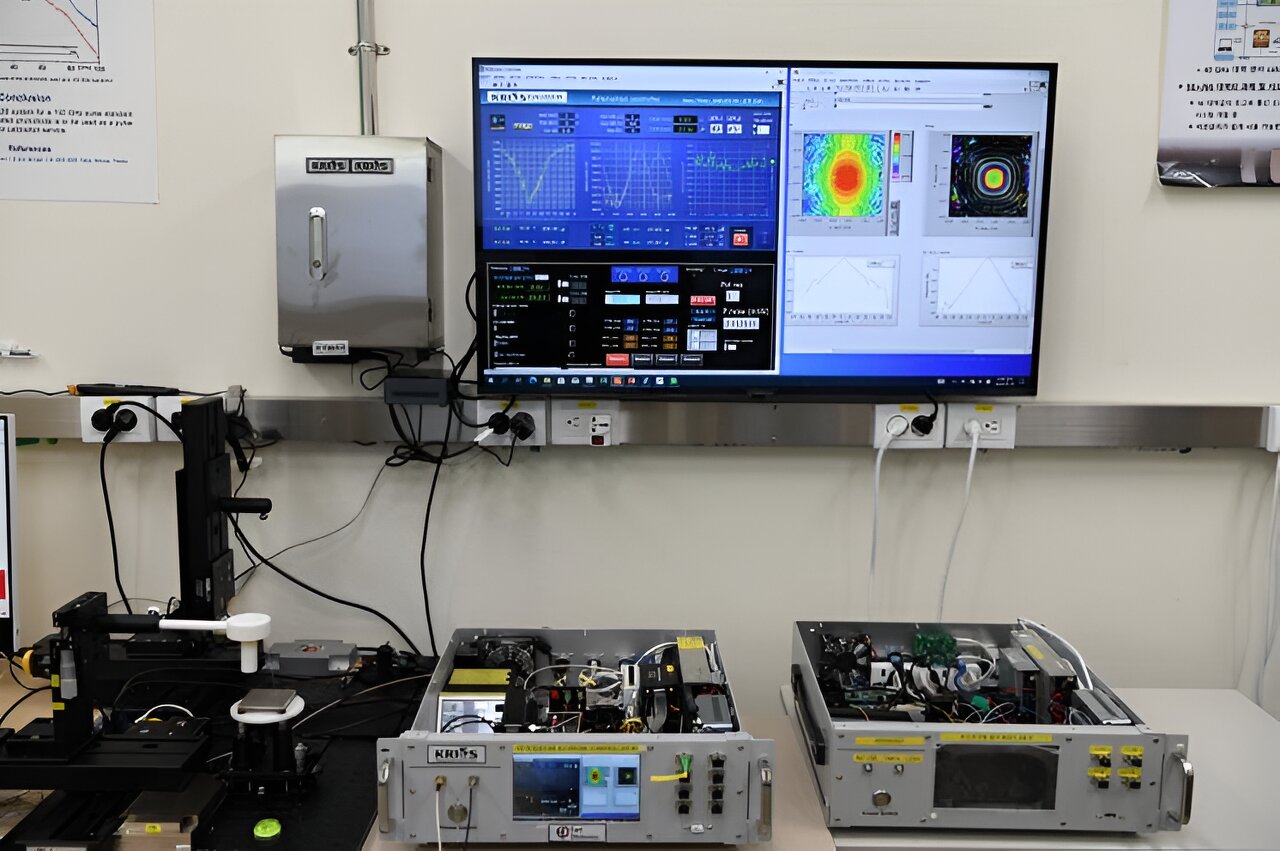
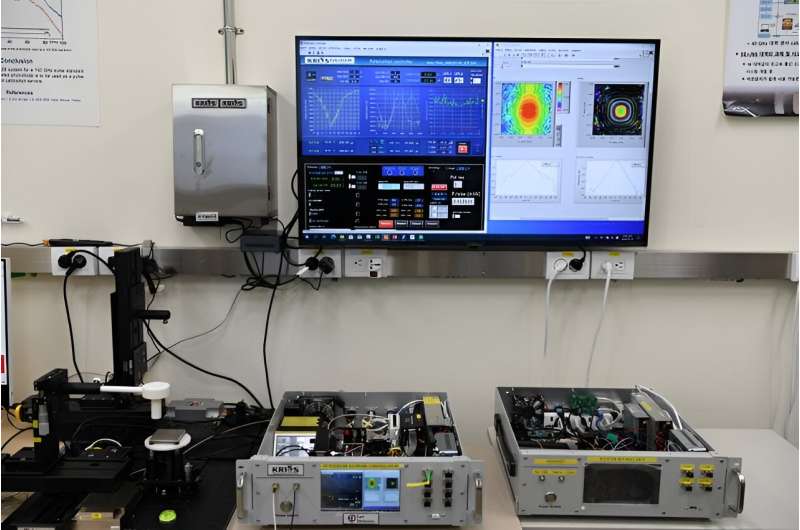
Mobile 6G antenna measurement system developed by KRISS. Courtesy of Korea Research Institute of Standards and Science (KRISS).
South Korea unveiled ambitious plans to become the first country in the world to launch 5G mobile communications services in April 2019. Although 5G has been commercialized in the 3.5 GHz band, the communication quality has not met consumer expectations. The installation of 28 GHz band base stations to provide true 5G services has been delayed due to concerns about profitability.
As a result, the government reclaimed spectrum from the three major telecommunications companies last year.As countries around the world prepare for the 6G era, it is time to reflect on the disappointing experience of 5G commercialization and focus on building 6G infrastructure.
The Korea Research Institute of Standards and Science (KRISS) has successfully developed domestic equipment to evaluate the performance of 6G communication antennas.
The paper is published in the journal IEEE Transactions on Metrology and Informatics.
Generally, as the frequency band increases, the communication speed increases, but the communication distance decreases. 6G communication (planned for 7 to 24 GHz) will use a higher frequency band than the current 5G communication (3.5 GHz), so antenna-related technology is required to solve the issue of shorter communication distance.
Accurate performance assessment is essential to ensure these advanced 6G antennas function properly. Accurate performance measurements help identify and correct causes of defects during the prototype stage, improving quality and accelerating time to mass production.
A research team from the KRISS Electromagnetic Measurement Group has developed a 6G antenna measurement system based on non-metallic sensors using optical techniques.
To evaluate the performance of an antenna, a sensor is placed at a certain distance to measure the electromagnetic waves emitted by the antenna. Previously, a metallic sensor was used, but a coupling effect occurred due to the electromagnetic wave reflection properties of metal, distorting the measurement results. This problem was easily solved by replacing it with a non-metallic sensor the size of a grain of rice.
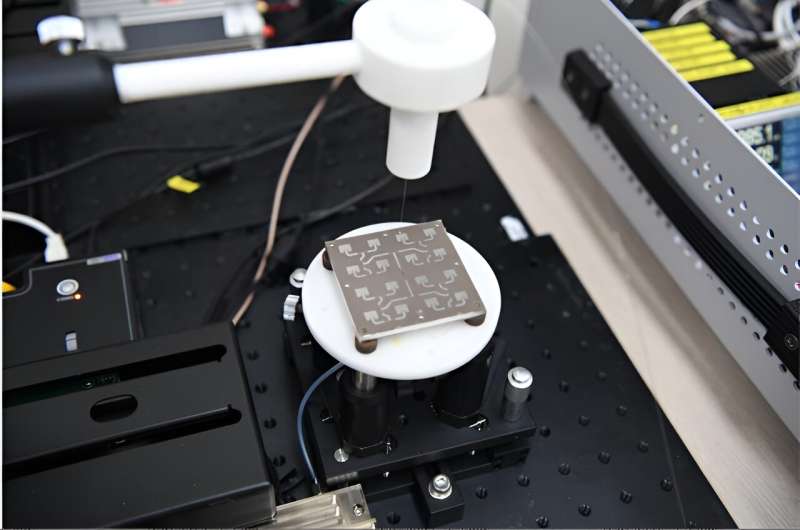
6G antenna performance measurement sensor developed by KRISS. Courtesy of Korea Research Institute of Standards and Science (KRISS).
The distance between the sensor and antenna during measurements has been reduced from several meters to a few millimeters, and measurement times have also been reduced by a factor of 10. Furthermore, unlike traditional measurements that require very large fixed facilities such as anechoic chambers, the measurement equipment developed by KRISS is lightweight and, with a size and weight comparable to that of a computer tower, is portable and suitable for use in standard laboratories.
KRISS transferred the technology to East Photonics, a company specializing in optical fiber communications and repeaters, for a usage fee of 300 million won, and a signing ceremony was held at the KRISS administration building on April 8.
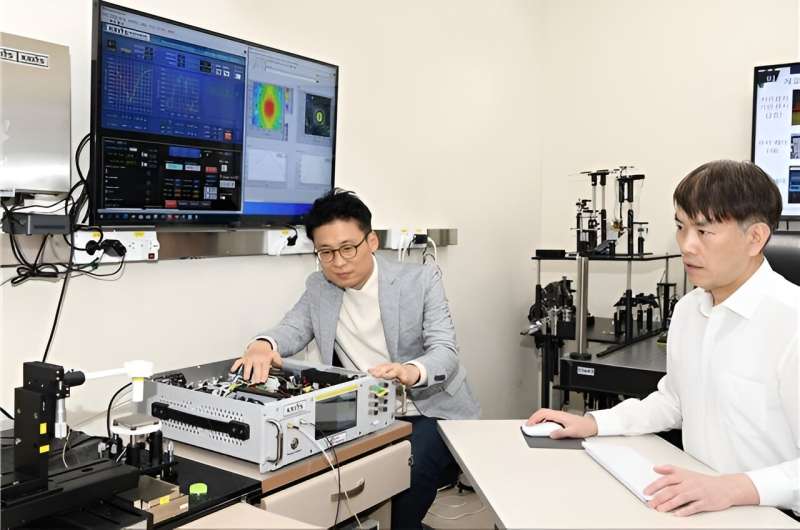
KRISS principal researchers Yongpyo Hong (left) and Dongjun Lee (right) use a new measurement system to test the performance of a 6G antenna prototype. Courtesy of Korea Research Institute of Standards and Science (KRISS)
“Currently, domestic research on 6G is focused on the areas of materials and components, with research on measuring equipment not yet done. Due to the disappointing experience with 5G communications in the 28GHz band, we plan to prioritize building 6G infrastructure, of which the development of measuring equipment is a key part,” said Hong Yeong-pyo, a principal researcher at KRISS.
East Photonics CEO Seok Ho-jun said, “All antenna measurement equipment for smartphones and base stations is expensive and made overseas, but from now on, we will work closely with KRISS to lead the domestic production of 6G antenna measurement equipment. Unlike existing measurement equipment, we plan to steadily commercialize it by leveraging our strengths in lightweight and portable measurement equipment.”
More information:
Dongjun Lee et al. “Integrated Electro-Optical Sensor for Measuring High-Power Electromagnetic Pulses” IEEE Transactions on Metrology and Informatics (2023). DOI: 10.1109/TIM.2023.3284921
Provided by the National Science and Engineering Research Council
Citation: Researchers successfully develop domestic 6G antenna measurement system (June 27, 2024) Retrieved August 18, 2024 https://techxplore.com/news/2024-06-successfully-domestic-6g-antenna.html
This document is subject to copyright. It may not be reproduced without written permission, except for fair dealing for the purposes of personal study or research. The content is provided for informational purposes only.
