

Have you ever wondered how an email sent from New York gets to Sydney in just seconds, or how you can video chat with someone halfway around the world with almost no delay? Behind these everyday miracles lies a vast network of invisible undersea cables, silently powering the instant global communications we have come to rely on.
Submarine cables, also known as submarine communication cables, are fiber optic cables that are laid on the ocean floor and used to transmit data between continents. These cables are the backbone of the worldwide Internet and carry the majority of international communications, such as emails, web pages, and video calls. More than 95% of all data moving around the world passes through these undersea cables.
These cables can transmit terabits of data per second, providing the fastest and most reliable data transfer method available today. Terabits per second is the speed that could instantly transmit about 12 of his 2-hour 4K HD movies. With just one of these cables, millions of people can watch videos and send messages at the same time without slowing down.
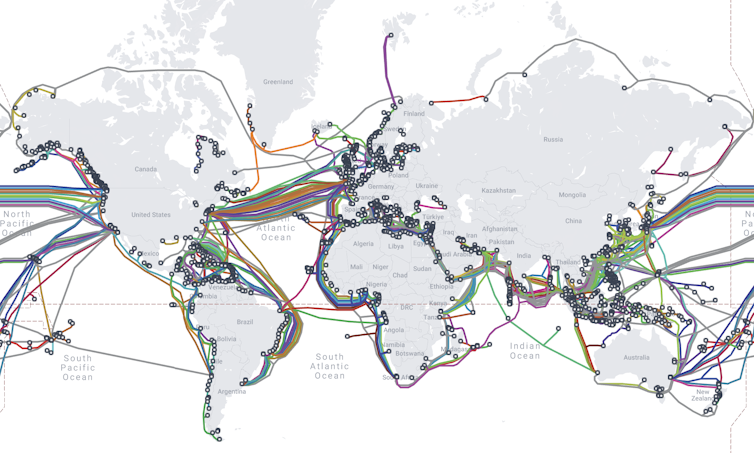
Approximately 485 submarine cables, totaling more than 900,000 miles, lie under the ocean. These cables span not only the Atlantic and Pacific Oceans, but also strategic passageways such as the Suez Canal and isolated areas within the ocean.
Telegeography, CC BY-SA
Laying cables underwater
Each submarine cable contains multiple optical fibers, thin strands of glass or plastic that use optical signals to transmit vast amounts of data over long distances with minimal loss. The fibers are bundled and wrapped in a protective layer designed to withstand the harsh undersea environment, including pressure, abrasion, and potential damage from fishing and ship anchors. The cable is usually about the same width as a garden hose.
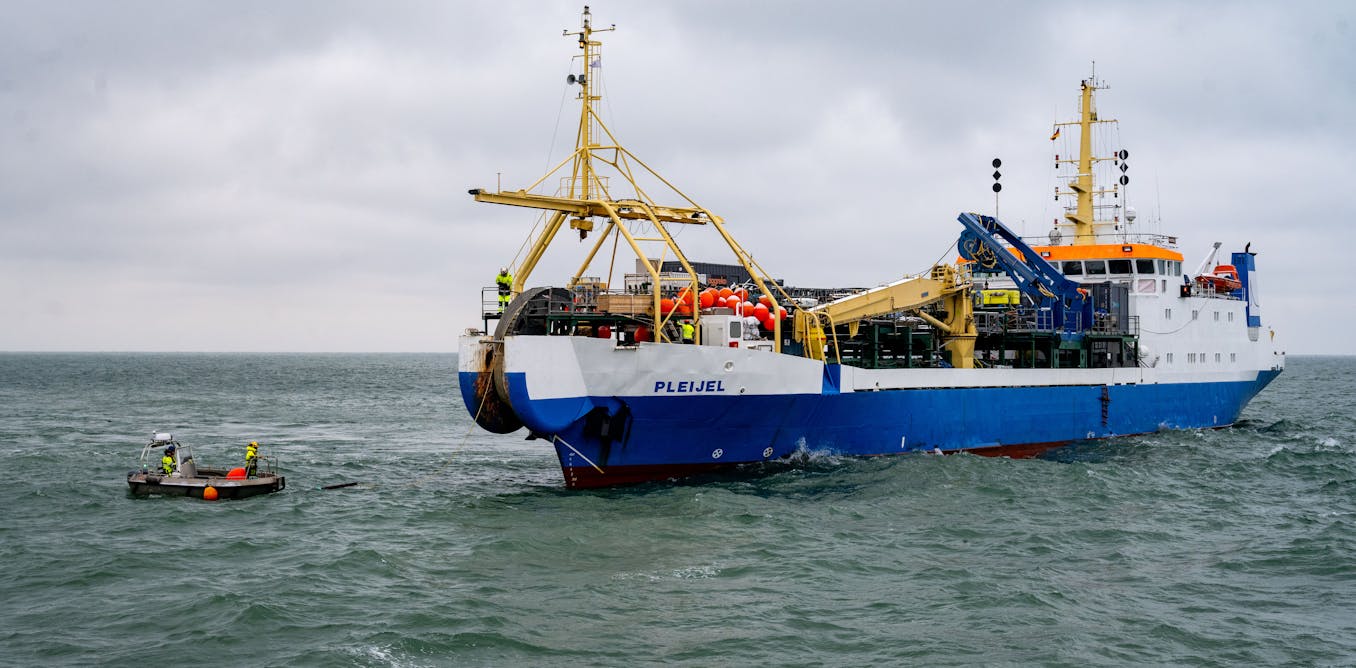
The process of laying submarine cables begins with a thorough seabed survey and mapping to avoid natural disasters and minimize environmental impact. Following this step, a cable-laying vessel equipped with a huge spool of fiber optic cable will sail along a predetermined route.
As the ship moves, the cable is unwound and carefully laid on the ocean floor. Cables are sometimes buried in seafloor sediments in shallow waters to protect them from fishing activities, anchors, and natural phenomena. In deeper locations, the cable is laid directly on the seabed.
Repeaters are installed at intervals along the route to amplify the optical signal and allow data to be transmitted over long distances without degradation. Depending on the length and complexity of the cabling, this entire process can take months or even years.
Threat of submarine cables
An estimated 100 to 150 submarine cables are severed each year, primarily due to accidents caused by fishing gear or anchors. However, there is growing concern about the potential for sabotage, particularly by nation-states. These cables are essential to global connectivity, are owned by a consortium of internet and telecommunications companies, are often located in isolated but publicly known locations, and are often targeted by hostile acts. It’s easy.
This vulnerability was highlighted on March 14, 2024, when multiple cables experienced unexplained failures off the coast of West Africa, causing severe internet outages affecting at least 10 countries. In 2023, multiple cable failures occurred in the Baltic Sea, raising suspicions of sabotage.
The strategic Red Sea corridor has emerged as a focal point for submarine cable threats. Notable incidents included an attack on the cargo ship Rubimar by Houthi rebels. The subsequent damage to undersea cables by a ship’s anchor not only disrupted a significant portion of Internet traffic between Asia and Europe, but also created complications between geopolitical conflicts and the safety of the world’s Internet infrastructure. highlighted the interaction.
cable protection
Undersea cables are protected in several ways, starting with strategic route planning to avoid known hazards and geopolitically sensitive areas. The cable is constructed from rugged materials, including a steel armor, to withstand harsh marine conditions and accidental impacts.
In addition to these measures, experts suggest establishing “cable protection zones” to limit high-risk activities near cables. Some have proposed amending international cable law to prevent foreign interference and creating a treaty that would make such interference illegal.
Recent events in the Red Sea show that the solutions to these connectivity challenges may lie above, not below. After cables were compromised in the area, satellite carriers rerouted Internet traffic using their networks. Although submarine cables will likely continue to carry the majority of the world’s internet traffic for the foreseeable future, a mixed approach using both submarine cables and satellites could provide protection against cable cuts. .
