

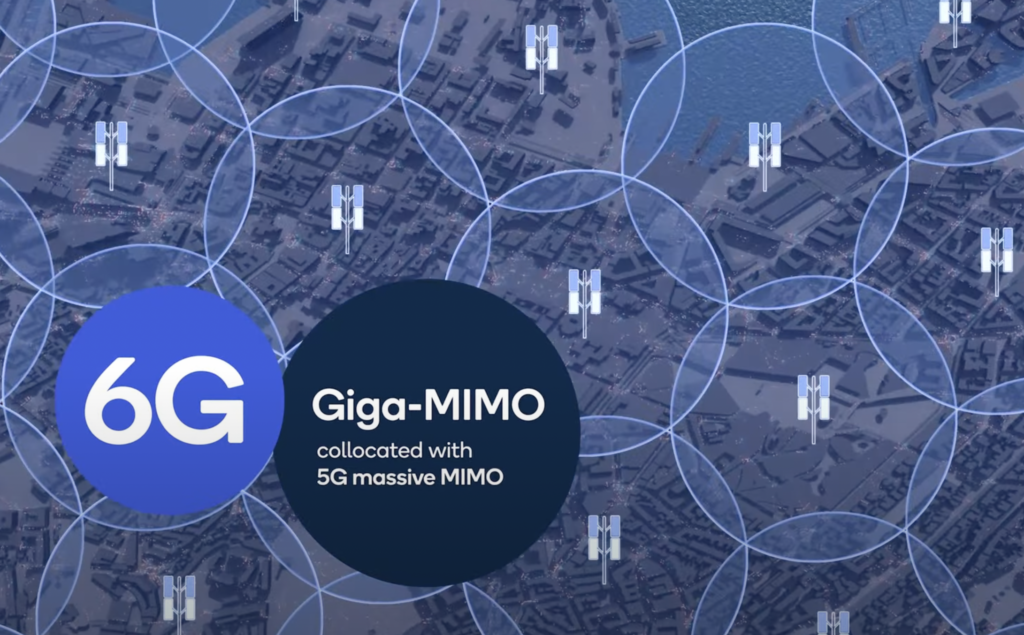
Evolution from Massive MIMO to Giga-MIMO facilitates fast and cost-effective 6G deployments
There is a global consensus that 7.1 GHz to 8.4 GHz is the primary 6G candidate band, and there is widespread interest in the upper midband (7 GHz to 16 GHz) for future mobile broadband services. And to be able to quickly and cost-effectively deploy wide-area coverage using these bands, Qualcomm has significantly increased the number of antenna elements compared to Massive MIMO systems, while Same footprint as 5G.
The general idea here is that the upper mid-band is used as the 6G coverage layer. Compare this to the mid-band (3.5 GHz) spectrum, which serves as the coverage layer for 5G. Qualcomm’s prototype Giga-MIMO system supports mobile communications in the 13 GHz band with 4,096 antenna elements and 256 digital chains in a form factor comparable to a 5G base station. The Giga-MIMO prototype is currently being tested in our laboratory and will soon be used for wireless testing at our California headquarters. The 16x increase in antenna elements compared to many massive MIMO systems provides significant beamforming gain for the same total conducted base station power. This means that 6G Giga MIMO and 5G Massive MIMO can coexist to achieve similar wide area coverage.
Tingfang Ji, vice president of engineering at Qualcomm, discussed wide area coverage by comparing 3.5 GHz and 7 GHz. The wavelength of 7 GHz is half that of 3.5 GHz, so the antenna size can be halved, although there will be some propagation loss. Increasing the number of antennas in an array allows for dB increases and beamforming, which can offset propagation losses as well as extend coverage. “People usually think that the higher the frequency, the harder it is to actually cover a large area. But what’s interesting is that as G advances, the creation of these massive MIMO arrays or giga-MIMO arrays will become more and more It’s just that we’re getting better at it…higher frequencies are not a problem as long as we can integrate more antennas.”
According to Ji, Qualcomm has been working on Giga-MIMO for about three years, going from hundreds of antenna elements with Massive MIMO and dozens of digital chains to thousands of antenna elements with Giga-MIMO and hundreds of Successfully transitioned to digital chain. “This year” at Mobile World Congress, “we’re bringing the hardware… to show people that they have the same form factor that they can actually get the same coverage.”
Citing Qualcomm’s parallel testing of Giga MIMO and Massive MIMO, Ji said the next step is to move to over-the-air testing using upper-midband compatible reference devices for “comprehensive comparisons.” Ta.
Looking to the larger long-term vision of 6G and the spectrum needs that come with it, Gee said that while upper midband will improve the overall capacity for wide area coverage, mmWave remains the “mainstay” driving hotspot capacity. ”. At the same time, sub-THz frequencies could potentially be used for sensing, fixed backhaul, data center applications, etc. “Our ambition is to not only enable operators to roll out new national networks and enable new services, but also incentivize them to upgrade their existing services,” he said. . While maintaining backward compatibility with existing 5G infrastructure and services, 6G will also “significantly improve operational efficiency across the network… Overall, it will deliver a 6G experience and enable 6G services. We need all the spectrum assets to do that. It’s a lot lower cost than 5G.”
With the technical pieces coming together and Qualcomm’s vice president of spectrum strategy expressing “cautious optimism” about spectrum availability, operators can ensure they make the necessary adjustments for commercialization. Ji emphasized that in order to do so, we need to think about the use cases and business cases for 6G. “Timing is everything,” he said. “Everything has to fall into place at the same time.”
