
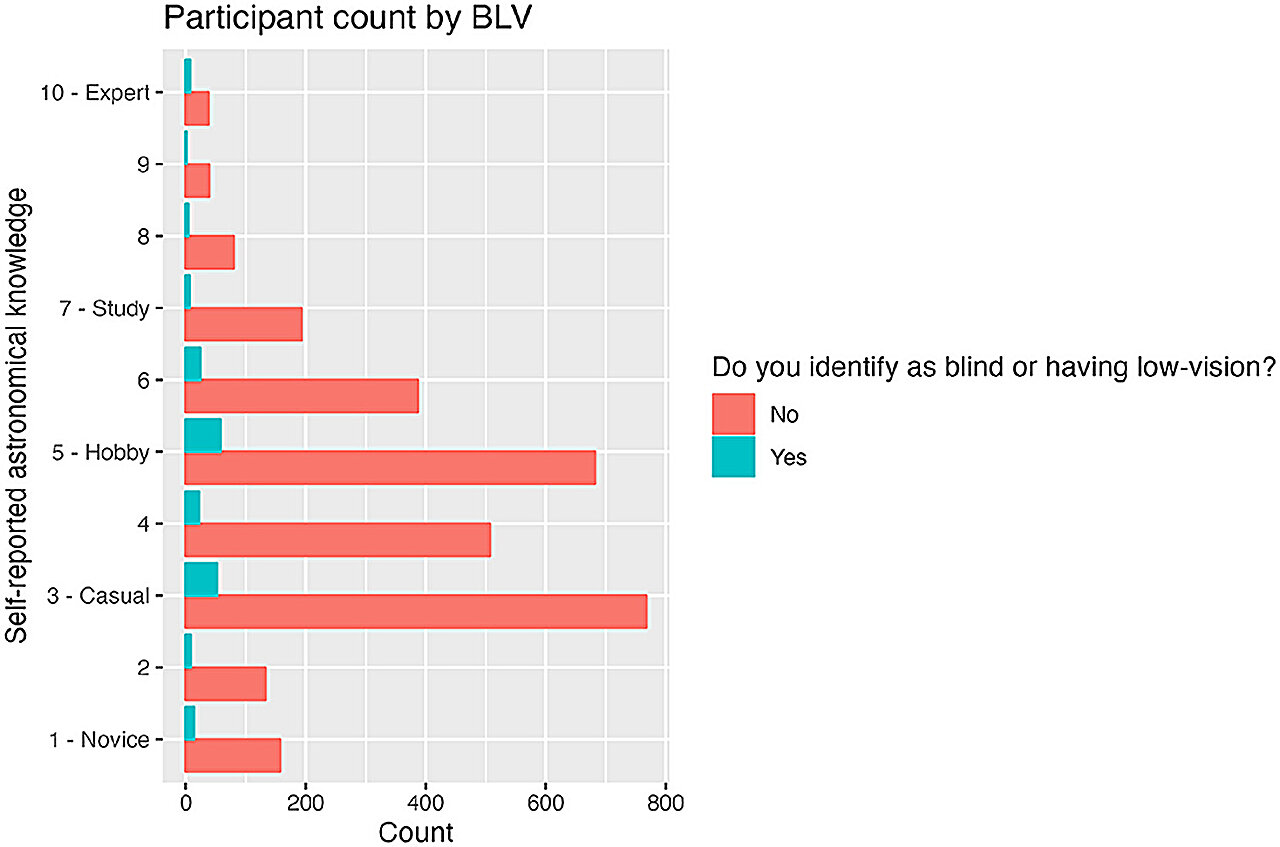
Histogram showing relative amounts of BLV and sighted subjects. Red (blue) bars represent sighted (BLV) participants. The X-axis shows the number of participants, and the Y-axis shows the self-reported level of astronomy knowledge from beginner to expert. Note the significant differences between BLV participants and sighted participants. Thirteen participants omitted astronomical knowledge or her BLV status and are omitted from this figure. credit: frontier of communication (2024). DOI: 10.3389/fcomm.2024.1288896
× close
Histogram showing relative amounts of BLV and sighted subjects. Red (blue) bars represent sighted (BLV) participants. The X-axis shows the number of participants, and the Y-axis shows the self-reported level of astronomy knowledge from beginner to expert. Note the significant differences between BLV participants and sighted participants. Thirteen participants omitted astronomical knowledge or her BLV status and are omitted from this figure. credit: frontier of communication (2024). DOI: 10.3389/fcomm.2024.1288896
When traveling to a place where a language you don’t understand is spoken, it’s usually important to find a way to translate what’s being communicated. In a sense, the same can be said about scientific data collected from space objects.
Telescopes like NASA’s Chandra X-ray Observatory capture X-rays invisible to the human eye from sources throughout the universe. Similarly, the James Webb Space Telescope captures infrared light, which is also invisible to the human eye. These different types of light are sent to Earth packed in the form of 1s and 0s. From there, the data is converted into a variety of formats, from plots to spectra to images.
This last category of images is probably what telescopes are best known for. However, for most of astronomy’s long history, most people who are blind or have low vision (BLV) have not been able to fully experience the data captured by these telescopes.
NASA’s Universe of Sound data sonification program works with NASA’s Chandra X-ray Observatory and NASA’s Universe of Learning to convert visual data of objects in space into sonified data. All telescopes in space, including the Chandra Space Telescope, the Webb Space Telescope, and dozens of other telescopes, must transmit the data they collect back to Earth as binary code or digital signals.
Typically, astronomers and others convert these digital data into images. The images are often spectacular and appear on everything from websites to pillowcases.
sphere music
However, the project’s experts put these data through another step to mathematically map the information to sound. This data-driven process is not a re-imagining of what the telescope has observed. It’s another kind of translation. It’s not a French to Mandarin translation, but a visual to audio translation.
Releases from the Universe of Sound sonification project are extremely popular among non-experts, ranging from viral news articles that potentially reach over 2 billion people, according to press statistics, to the regular Chandra. si.edu website traffic triples.
But how is such data sonification perceived by people, especially members of the BLV community? How does data sonification impact participants’ learning, enjoyment, and exploration of astronomy? Can translating scientific data into speech enable emotional or intellectual trust and investment in scientific data? Will it help raise awareness of the accessibility needs you may have?
listen carefully
This study used sonified NASA data for three objects. We surveyed people who were blind or visually impaired and sighted to better understand participants’ experiences of sonification in relation to enjoyment, understanding, and trust in scientific data. Data analysis from 3,184 blind or visually impaired participants yielded significant improvements in self-reported learning and positive experiential responses.
As a result, multisensory astrophysical data such as sonification establishes further avenues of trust, increases access, and promotes accessibility awareness in the sighted, visually impaired, or partially sighted community. We showed that it is possible. In short, sonication helped people access and engage with space.
Sonification is an evolving collaborative field. This is a project done by BLV Partnership as well as for his BLV community. A new documentary available on NASA’s free streaming platform NASA+ explores how these changes are made and the team behind them. The hope is that sonification will help communicate our scientific discoveries from space to a wider audience, opening the door to space a little wider for everyone.
Research results will be published in a magazine frontier of communication.
For more information:
Kimberly Kowal Arcand et al, “A Universe of Sound: Sonicating and Processing NASA Data and Studying Participant Responses.” frontier of communication (2024). DOI: 10.3389/fcomm.2024.1288896
